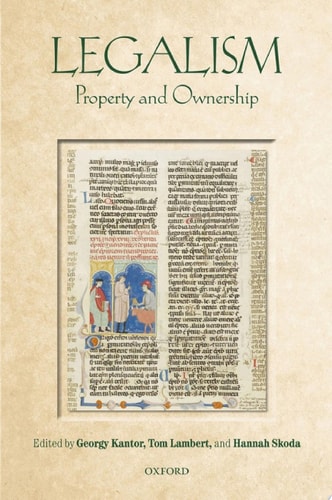
Legalism: Property and Ownership
0
0
As an Amazon Associate and affiliate partner, Menrva Books earns from qualifying purchases. Learn more
Author Description
In this volume, ownership is defined as the simple fact of being able to describe something as 'mine' or 'yours', and property is distinguished as the discursive field which allows the articulation of attendant rights, relationships, and obligations. Property is often articulated through legalism as a way of thinking that appeals to rules and to generalizing concepts as a way of understanding, responding to, and managing the world around one. An Aristotelian perspective suggests that ownership is the natural state of things and a prerequisite of a true sense of self. An alternative perspective from legal theory puts law at the heart of the origins of property. However, both these points of view are problematic in a wider context, the latter because it rests heavily on Roman law. Anthropological and historical studies enable us to interrogate these assumptions. The articles here, ranging from Roman provinces to modern-day piracy in Somalia, address questions such as: How are legal property regimes intertwined with economic, moral-ethical, and political prerogatives? How far do the assumptions of the western philosophical tradition explain property and ownership in other societies? Is the 'bundle of rights' a useful way to think about property? How does legalism negotiate property relationships and interests between communities and individuals? How does the legalism of property respond to the temporalities and materialities of the objects owned? How are property regimes managed by states, and what kinds of conflicts are thus generated? Property and ownership cannot be reduced to natural rights, nor do they straightforwardly reflect power relations: the rules through which property is articulated tend to be conceptually subtle. As the fourth volume in the Legalism series, this collection draws on common themes that run throughout the first three volumes: Legalism: Anthropology and History, Legalism: Community and Justice, and Legalism: Rules and Categories consolidatin
Menrva's Summary
THE THESIS
This volume investigates the conceptual distinction between ownership as a personal claim and property as a discursive legal framework. The editors, Georgy Kantor, Hannah Skoda, and Tom Lambert, curate a collection of scholarly articles that challenge the traditional Aristotelian view of ownership as a natural state and the Roman law-centric view of property as a purely legal construct. By integrating anthropological and historical data, the authors argue that property regimes are complex, subtle systems that intersect with economic, moral, and political spheres rather than existing as static natural rights.
THE SCOPE MAP
What You Will Find
- Comparative analysis of property regimes across diverse historical and geographical contexts, from Roman provinces to modern-day Somalia.
- Theoretical interrogation of the 'bundle of rights' concept in property law.
- Examination of how legalism manages the relationship between individual interests and community obligations.
- Discussion on the interaction between legal rules and the material nature of owned objects.
Scope Limits
- The text does not provide a comprehensive manual for modern property litigation or specific jurisdictional statutes.
- It does not offer a singular, unified theory of property, focusing instead on the plurality of legalistic approaches.
THE AUTHORITY PERSPECTIVE
Scholars and legal historians recognize this volume as a significant contribution to the interdisciplinary study of legalism and social organization. Readers frequently note the academic density of the prose, which is intended for researchers and students of legal theory and anthropology.
Page Count:
304
Publication Date:
2017-01-01
Publisher:
OUP Oxford
ISBN-10:
0192543768
ISBN-13:
9780192543769
Philosophy
Law
Sociology
Property Law
Legal History
LAW Property
Professional Career & Trade
Anthropology
Community Tags
Similar Books





Reader Comments
Share Your Thoughts
No comments yet. Be the first to share your thoughts!