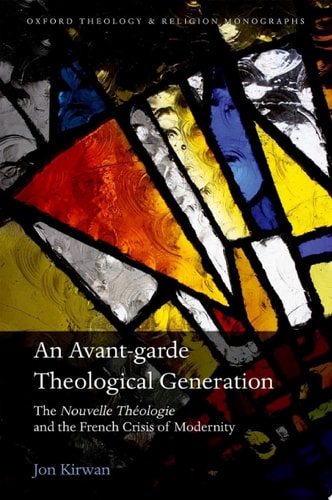
An Avant-garde Theological Generation: The Nouvelle Théologie and the French Crisis of Modernity
0
0
As an Amazon Associate and affiliate partner, Menrva Books earns from qualifying purchases. Learn more
Author Description
An Avant-garde Theological Generation examines the Fourvière Jesuits and Le Saulchoir Dominicans, theologians and philosophers who comprised the influential reform movement the nouvelle théologie. Led by Henri de Lubac, Jean Daniélou, Yves Congar, and Marie-Dominique Chenu, the movement flourished from the 1930s until its suppression in 1950. It aims to remedy certain historical deficiencies by constructing a history both sensitive to the wider intellectual, political, economic, and cultural milieu of the French interwar crisis, and that establishes continuity with the Modernist crisis and the First World War. Chapter One examines the modern French avant-garde generations that have shaped intellectual and political thought in France, providing context for a historical narrative of the nouvelle théologie. Chapters Two and Three examine the influential older generations that flourished from 1893 to 1914, such as the Dreyfus generation, the generation of Catholic Modernists, and two generations of older Jesuits and Dominicans, which were instrumental in the Fourvière Jesuits' development. Chapter Four explores the influence of the First World War and the years of the 1920s, during which the Jesuits and Dominicans were in religious and intellectual formation, relying heavily on unpublished letters and documents from the Jesuits archives in Paris (Vanves). Chapter Five analyses the crises of the interwar period and the emergence of the wider generation of 1930--to which the nouveaux théologiens belonged--and its intellectual thirst for revolution. Chapter Six examines the emergence of the ressourcement thinkers during the tumultuous years of the 1930s. The decade of the 1940s, explored in Chapter Seven, saw the rise to prominence of the members of the generation of 1930, who, thanks to their participation in the resistance, emerged from the Second World War, with significant influence on the postwar French intellectual milieu. Finally, the monograph concludes in Chapte
Menrva's Summary
THE THESIS
This monograph investigates the historical and intellectual origins of the nouvelle théologie movement, questioning how the French interwar crisis shaped the theological reform efforts of the Fourvière Jesuits and Le Saulchoir Dominicans. Jon Kirwan, a scholar of modern religious history, utilizes archival research and historical contextualization to argue that this movement was not an isolated theological development but a product of the broader French intellectual and cultural milieu. By tracing the lineage of these thinkers from the Modernist crisis through the Second World War, the text establishes a framework for understanding their eventual influence on postwar Catholic thought.
THE SCOPE MAP
What You Will Find
- A detailed historical analysis of the Fourvière Jesuits and Le Saulchoir Dominicans from 1930 to 1950.
- Examination of the influence of the Dreyfus generation and Catholic Modernists on later theological development.
- Analysis of the impact of the First World War and the interwar period on religious formation.
- Use of unpublished letters and documents from Jesuit archives in Paris.
Scope Limits
- The study focuses primarily on the French intellectual context and does not provide an exhaustive global history of the movement.
- The narrative concludes its primary analysis at the end of the 1940s and does not track the long-term legacy of the movement into the late 20th century.
THE AUTHORITY PERSPECTIVE
Scholars and historians of religion frequently cite this work for its rigorous use of archival materials and its ability to situate theological debates within the specific political and cultural crises of 20th-century France. Readers often note the academic density of the prose, which serves as a foundational resource for those studying the intersection of French intellectual history and Catholic theology.
Page Count:
325
Publication Date:
2018-01-01
Publisher:
OUP Oxford
ISBN-10:
0192551272
ISBN-13:
9780192551276
Religion
History
Philosophy
Catholicism
Theology
French History
Community Tags
Similar Books