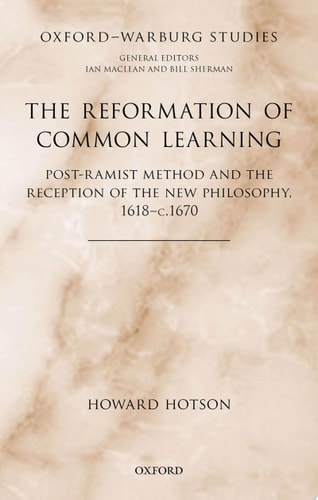
The Reformation of Common Learning
0
0
As an Amazon Associate and affiliate partner, Menrva Books earns from qualifying purchases. Learn more
Author Description
Ramism Was The Most Innovative And Disruptive Educational Reform Movement To Sweep Through The International Protestant World In The Latter Sixteenth And Early Seventeenth Centuries. During The 1620s, The Thirty Years' War Destroyed The Network Of Central European Academies And Universities Which Had Generated Most Of This Innovation. Students And Teachers, Fleeing The Conflict In All Directions, Transplanted That Tradition Into Many Different Geographical And Cultural Contexts In Which It Bore Are Wide Variety Of Interrelated Fruit. Within The Dutch Republic, Post-ramist Method Played A Crucial Role In The Rapid Assimilation Of Cartesianism Into A Network Of Thriving Young Academies And Universities. From England To East-central Europe, The Tradition Was No Less Important In Accelerating The Reception Of Baconianism. In The Easternmost Outpost Of The Reformed World In Transylvania, The Displaced Tradition Generated A Final Flourishing Of Philosophical Innovation Which Exercised A Formative Influence On The Young Leibniz. The Failure Of All Of These Efforts To Assemble The Fruits Of This Tradition Into An Encyclopaedic Synthesis Marks A Major Watershed In Western Intellectual History. The Reformation Of Common Learning Brings Together All Of These Aspects Of The Tradition In A Manner Which Roots Them In Deeper Historical Developments And Relates A Series Of Far-flung And Poorly Understood Developments Together In New Ways.
Menrva's Summary
THE THESIS
This work investigates how the Ramist educational reform movement, disrupted by the Thirty Years' War, influenced the development of modern intellectual traditions across Europe. Howard Hotson, a scholar of early modern intellectual history, utilizes extensive archival research to trace the migration of Ramist pedagogical methods. He argues that the displacement of these scholars facilitated the integration of Cartesianism and Baconianism, ultimately shaping the philosophical landscape that influenced thinkers like Leibniz.
THE SCOPE MAP
What You Will Find
- Analysis of the Ramist educational network in the sixteenth and seventeenth centuries
- Examination of the impact of the Thirty Years' War on academic migration
- Case studies on the reception of Cartesianism and Baconianism in the Dutch Republic and England
- Exploration of the philosophical developments in Transylvania
Scope Limits
- The text does not provide a comprehensive biography of individual Ramist scholars
- It does not cover the influence of Ramism outside of the European Protestant context
THE AUTHORITY PERSPECTIVE
Scholars recognize this text as a significant contribution to the understanding of early modern intellectual networks and pedagogical history. Readers frequently note the academic density of the prose, which requires a foundational knowledge of seventeenth-century European history to fully appreciate the arguments presented.
Page Count:
464
Publication Date:
2020-01-01
Publisher:
Oxford University Press
ISBN-10:
0192552961
ISBN-13:
9780192552969
Philosophy
History
Intellectual History
Early Modern
Reformation
Education
Community Tags
Similar Books