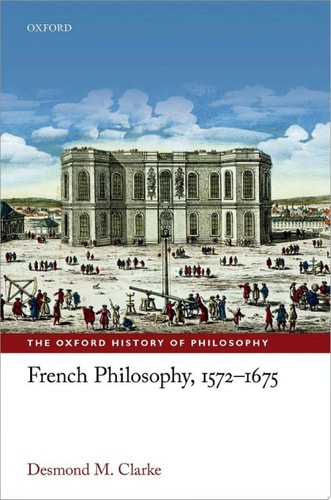
French Philosophy, 1572-1675
0
0
As an Amazon Associate and affiliate partner, Menrva Books earns from qualifying purchases. Learn more
Author Description
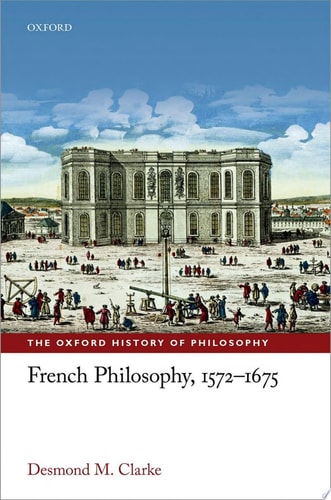
Desmond M. Clarke presents a thematic history of French philosophy from the middle of the sixteenth century to the beginning of Louis XIV's reign. While the traditional philosophy of the schools was taught throughout this period by authors who have faded into permanent obscurity, a whole generation of writers who were not professional philosophers—some of whom never even attended a school or college—addressed issues that were prominent in French public life. Clarke explores such topics as the novel political theory espoused by monarchomachs, such as Bèze and Hotman, against Bodin's account of absolute sovereignty; the scepticism of Montaigne, Charron, and Sanches; the ethical discussions of Du Vair, Gassendi, and Pascal; innovations in natural philosophy that were inspired by Mersenne and Descartes and implemened by members of the Académie royale des sciences; theories of the human mind from Jean de Silhon to Cureau de la Chambre and Descartes; and the novel arguments in support of women's education and equality that were launched by De Gournay, Du Bosc, Van Schurman and Poulain de la Barre. The writers involved were lawyers, political leaders, theologians, and independent scholars and they acknowledged, almost unanimously, the authority of the Bible as a source of knowledge that was claimed to be more reliable than the fragile powers of human understanding. Since they could not agree, however, on which books of the Bible were canonical or how that should be understood, their discussions raised questions about faith and reason that mirrored those involved in the infamous Galileo affair.
Menrva's Summary
THE THESIS
How did non-professional thinkers in France between 1572 and 1675 reconcile the authority of the Bible with the emerging demands of human reason and scientific inquiry? Desmond M. Clarke, an expert in seventeenth-century philosophy, provides a thematic examination of this intellectual period. He argues that the most significant philosophical contributions were made by individuals outside the traditional academic establishment, such as lawyers, theologians, and independent scholars, who navigated the tension between religious dogma and the rise of modern natural philosophy.
THE SCOPE MAP
What You Will Find
- Analysis of political theories regarding absolute sovereignty versus monarchomach resistance.
- Examination of skepticism, ethics, and theories of the human mind.
- Discussion of early arguments for gender equality and women's education.
- Contextualization of the Galileo affair within French intellectual debates.
Scope Limits
- The text does not focus on the traditional scholastic philosophy taught within formal university curricula.
- It does not provide a comprehensive biography of every philosopher mentioned, focusing instead on thematic contributions.
THE AUTHORITY PERSPECTIVE
Scholars recognize this work as a significant contribution to the history of ideas, particularly for its focus on thinkers outside the traditional philosophical canon. Readers frequently note the academic density of the prose and the author's meticulous attention to the intersection of theology and early modern science.
Page Count:
291
Publication Date:
2016-01-01
Publisher:
OUP Oxford
ISBN-10:
0191066516
ISBN-13:
9780191066511
Philosophy
History
Philosophy French
Early Modern
Intellectual History
History & Surveys
French History