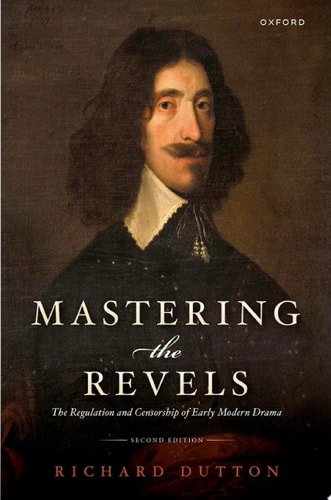
Mastering the Revels: The Regulation and Censorship of Early Modern Drama
0
0
As an Amazon Associate and affiliate partner, Menrva Books earns from qualifying purchases. Learn more
Author Description
Mastering the Revels traces the measures taken by the governments of Elizabeth I, James I, and Charles I to regulate the new phenomenon of fixed playhouses and resident playing companies in London, and to censor their plays. It focuses on the Masters of the Revels, whose primary function was to seek out theatrical entertainment for the court but whose role expanded to include oversight of the players and their playhouses. The book proceeds chronologically, tracking each of the Masters in the period--Edmund Tilney (served 1579-1610), Sir George Buc (1610-22), Sir John Astley (1622-3), and Sir Henry Herbert (1623-1642). Tilney was the first to receive a Special Commission giving him wide-ranging powers over the players. When Buc first became involved is examined here in detail, as is the parallel history of the Children of the Queen's Revels who between 1604 and 1608 staged some of the most scandalous plays of the era. Astley succeeded Buc, but soon sold the office to Herbert, who then served to the closing of the theatres. Manuscripts of plays censored by Tilney, Buc, and Herbert have survived and are examined in detail to assess their concerns. Large parts of Herbert's office-book have also survived, giving detailed insights into his professional life, including interactions with both the court and the players. It reveals the difficulties he faced negotiating recurrent popular pressure for war against Spain, resistance to Archbishop Laud's reforms of the church, and Henrietta Maria's problematic presence as a Catholic queen to Charles I.
Menrva's Summary
THE THESIS
This work investigates how the office of the Master of the Revels functioned as a mechanism for state regulation and censorship of the London theater industry during the reigns of Elizabeth I, James I, and Charles I. Richard Dutton, a scholar of early modern drama, utilizes surviving manuscripts, office-books, and historical records to reconstruct the professional lives of the men who held this office. He argues that the role evolved from simple court entertainment procurement into a complex instrument of political and religious control over the burgeoning playhouse scene.
THE SCOPE MAP
What You Will Find
- A chronological analysis of the Masters of the Revels from 1579 to 1642.
- Detailed examination of censored play manuscripts and the office-book of Sir Henry Herbert.
- Historical context regarding the political pressures of the era, including the influence of the Spanish wars and religious reform.
Scope Limits
- The study is restricted to the period ending with the closure of the theaters in 1642.
- It focuses primarily on the administrative and regulatory functions of the Master of the Revels rather than the aesthetic analysis of the plays themselves.
THE AUTHORITY PERSPECTIVE
Scholars frequently cite this text as a foundational resource for understanding the intersection of state power and theatrical production in the early modern period. Readers often note the academic rigor and the detailed archival research that characterizes Dutton's examination of the Master of the Revels' office.
Page Count:
413
Publication Date:
2022-01-01
Publisher:
OUP Oxford
ISBN-10:
019255154X
ISBN-13:
9780192551542
History
Drama
English literature
Literary Criticism
Indigenous
Early Modern
Theater History
Censorship
Community Tags
Similar Books