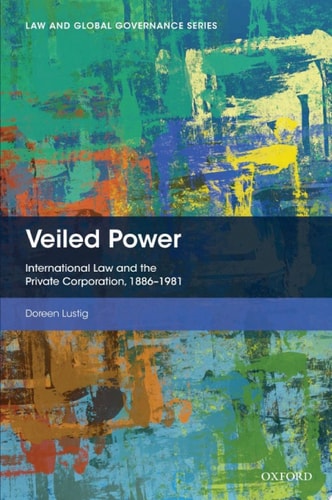
Veiled Power: International Law and the Private Corporation 1886-1981
0
0
As an Amazon Associate and affiliate partner, Menrva Books earns from qualifying purchases. Learn more
Author Description
Veiled Power conducts a thorough historical study of the relationship between international law and business corporations. It chronicles the emergence of the contemporary legal architecture for corporations in international law between 1886 and 1981. Doreen Lustig traces the relationship between two legal 'veils': the sovereign veil of the state and the corporate veil of the company. The interplay between these two veils constitutes the conceptual framework this book offers for the legal analysis of corporations in international law. By weaving together five in-depth case studies - Firestone in Liberia, the Industrialist Trials at Nuremberg, the Anglo-Iranian Oil Company, Barcelona Traction and the emergence of the international investment law regime - a variety of contexts are covered, including international criminal law, human rights, natural resources, and the multinational corporation as a subject of regulatory concern. Together, these case studies offer a multifaceted account of the history of corporations in international law over time. The book seeks to demonstrate the facilitative role of international law in shaping and limiting the scope of responsibility of the private business corporation from the late-nineteenth century and throughout the twentieth century. Ultimately, Lustig suggests that, contrary to the prevailing belief that international law failed to adequately regulate private corporations, there is a history of close engagement between the two that allowed corporations to exert influence under a variety of legal regimes while obscuring their agency.
Menrva's Summary
THE THESIS
This book investigates the historical evolution of the relationship between international law and the private business corporation from 1886 to 1981. Doreen Lustig, a scholar in international law, utilizes a framework centered on the interplay between the sovereign veil of the state and the corporate veil of the company. She argues that international law has historically played a facilitative role in shaping corporate responsibility, often allowing firms to exert significant influence while simultaneously obscuring their agency within global regulatory regimes.
THE SCOPE MAP
What You Will Find
- Historical analysis of corporate legal architecture between 1886 and 1981
- A conceptual framework utilizing the dual-veil theory of state and corporate sovereignty
- Five detailed case studies: Firestone in Liberia, the Industrialist Trials at Nuremberg, the Anglo-Iranian Oil Company, Barcelona Traction, and the emergence of international investment law
Scope Limits
- The analysis focuses primarily on the period ending in 1981 and does not cover contemporary 21st-century corporate regulatory developments
- The study is limited to the specific interaction between international legal frameworks and multinational entities rather than domestic corporate law
THE AUTHORITY PERSPECTIVE
Legal scholars and historians recognize this work as a significant contribution to the understanding of how corporations have navigated international legal systems. Readers frequently note the academic density of the prose and the meticulous archival research that supports Lustig's re-evaluation of corporate accountability.
Page Count:
249
Publication Date:
2020-01-01
Publisher:
OUP Oxford
ISBN-10:
019255526X
ISBN-13:
9780192555267
Professional Career & Trade
Legal History
Corporate Law
International Law
Law
Community Tags
Similar Books