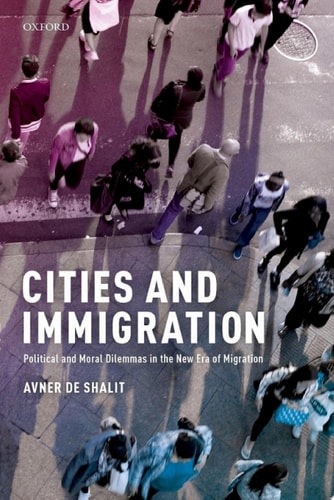
Cities and Immigration: Political and Moral Dilemmas in the New Era of Migration
0
0
As an Amazon Associate and affiliate partner, Menrva Books earns from qualifying purchases. Learn more
Author Description
All over the world immigration is one of the most urgent political issues, creating tensions and unrest as well as questions of justice and fairness. Academics as well as politicians have been relating to the question of how states should cope with immigrants; but 96% of immigrants end up in cities, and in Europe and the USA, two thirds of the immigrants settle in seven or eight cities. Indeed, most of us encounter with immigrants as city-zens, in our everyday life, rather than as citizens of states. So how should cities integrate immigrants? Should cities be allowed to design their autonomous integration policies? Could they issue visas and permits to immigrants? Should immigrants be granted voting rights in local elections before naturalization? And how do cities think about these issues? What can we learn from cities which are thought to be successful in integrating and assimilating immigrants? Is there a model of integration within the city which is best? The book discusses these questions both empirically and normatively. The book is based on hundreds of in depth discussions of these matters with city dwellers in San Francisco, New York, London, Amsterdam, Berlin, Thessaloniki and Jerusalem. It shifts the discourse on immigration from 'thinking like a state' to 'thinking like a city'.
Menrva's Summary
THE THESIS
This book investigates how the focus of immigration policy should shift from the nation-state level to the municipal level to better address the practical and moral challenges of integration. Prof. Avner de Shalit, a political theorist, utilizes a normative and empirical framework to argue that because the vast majority of immigrants settle in urban centers, cities must be empowered to develop autonomous integration strategies. He challenges traditional state-centric discourse by examining how local governance can foster more effective and equitable inclusion for new arrivals.
THE SCOPE MAP
What You Will Find
- Comparative analysis of immigration policies in seven major global cities: San Francisco, New York, London, Amsterdam, Berlin, Thessaloniki, and Jerusalem.
- Ethical arguments regarding local voting rights for non-naturalized immigrants.
- Empirical data derived from hundreds of in-depth interviews with diverse city dwellers.
Scope Limits
- The text does not provide a universal blueprint for integration, acknowledging that local contexts vary significantly.
- It does not focus on national-level border security or macro-economic immigration policy.
THE AUTHORITY PERSPECTIVE
Scholars and urban policy experts recognize this work as a significant contribution to the shift toward municipal-level political theory. Readers frequently note the accessible yet rigorous nature of the author's arguments, which bridge the gap between abstract political philosophy and practical urban governance.
Page Count:
178
Publication Date:
2018-01-01
Publisher:
OUP Oxford
ISBN-10:
019256966X
ISBN-13:
9780192569660
Sociology
Ethics
Public Policy
Immigration
Urban Studies
Community Tags
Similar Books