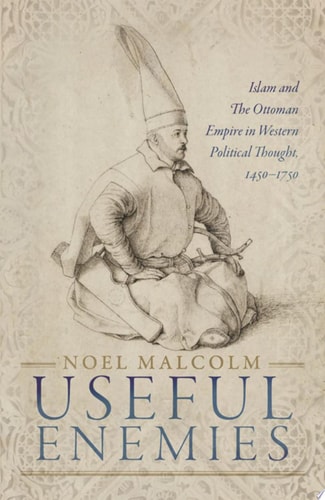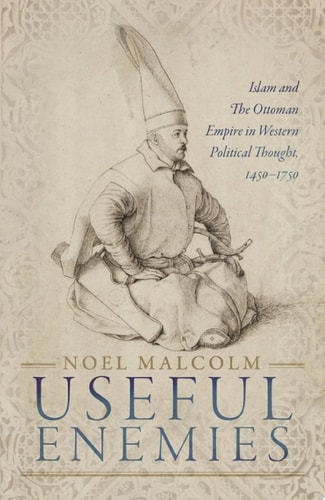
Useful Enemies: Islam and the Ottoman Empire in Western Political Thought, 1450-1750
0
0
As an Amazon Associate and affiliate partner, Menrva Books earns from qualifying purchases. Learn more
Author Description
From the fall of Constantinople in 1453 until the eighteenth century, many Western European writers viewed the Ottoman Empire with almost obsessive interest. Typically they reacted to it with fear and distrust; and such feelings were reinforced by the deep hostility of Western Christendom towards Islam. Yet there was also much curiosity about the social and political system on which the huge power of the sultans was based. In the sixteenth century, especially, when Ottoman territorial expansion was rapid and Ottoman institutions seemed particularly robust, there was even open admiration. In this path-breaking book Noel Malcolm ranges through these vital centuries of East-West interaction, studying all the ways in which thinkers in the West interpreted the Ottoman Empire as a political phenomenon - and Islam as a political religion. Useful Enemies shows how the concept of 'oriental despotism' began as an attempt to turn the tables on a very positive analysis of Ottoman state power, and how, as it developed, it interacted with Western debates about monarchy and government. Noel Malcolm also shows how a negative portrayal of Islam as a religion devised for political purposes was assimilated by radical writers, who extended the criticism to all religions, including Christianity itself. Examining the works of many famous thinkers (including Machiavelli, Bodin, and Montesquieu) and many less well-known ones, Useful Enemies illuminates the long-term development of Western ideas about the Ottomans, and about Islam. Noel Malcolm shows how these ideas became intertwined with internal Western debates about power, religion, society, and war. Discussions of Islam and the Ottoman Empire were thus bound up with mainstream thinking in the West on a wide range of important topics. These Eastern enemies were not just there to be denounced. They were there to be made use of, in arguments which contributed significantly to the development of Western political thought.
Menrva's Summary
THE THESIS
This book investigates how Western European political thinkers between 1450 and 1750 utilized the Ottoman Empire and Islam as conceptual tools to navigate and shape their own internal debates regarding governance, religion, and power. Noel Malcolm, a senior research fellow and historian, synthesizes a vast array of primary source texts from the early modern period to demonstrate that Western perceptions of the East were rarely objective observations. Instead, he argues that these perceptions were strategically constructed to serve domestic political agendas, ultimately influencing the trajectory of Western political philosophy.
THE SCOPE MAP
What You Will Find
- Analysis of political writings from 1450 to 1750 regarding the Ottoman state.
- Examination of the evolution of the concept of 'oriental despotism' as a rhetorical device.
- Case studies of influential thinkers including Machiavelli, Bodin, and Montesquieu.
- Exploration of how critiques of Islam were repurposed to challenge Christian institutions.
Scope Limits
- The study focuses primarily on Western European intellectual output rather than Ottoman internal history.
- The analysis is restricted to the period between the fall of Constantinople and the mid-eighteenth century.
THE AUTHORITY PERSPECTIVE
Scholars and historians recognize this work as a rigorous contribution to the field of intellectual history, frequently noting the depth of the author's archival research. Experts highlight the text as a significant resource for understanding how external 'others' are integrated into the development of domestic political theory.
Page Count:
501
Publication Date:
2019-01-01
Publisher:
OUP Oxford
ISBN-10:
0192565818
ISBN-13:
9780192565815
History
Ottoman Empire
History of the Americas
European History
Religion and Politics
Intellectual History
Community Tags
Similar Books