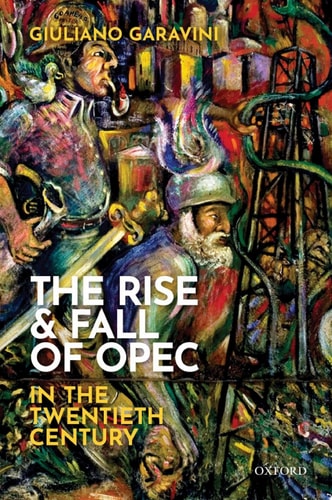
The Rise and Fall of OPEC in the Twentieth Century
0
0
As an Amazon Associate and affiliate partner, Menrva Books earns from qualifying purchases. Learn more
Author Description
The Organization of the Petroleum Exporting Countries (OPEC) is one of the most recognizable acronyms among international organizations. It is mainly associated with the 'oil shock' of 1973 when prices of petroleum quadrupled and industrialized countries and consumers were forced to face the limits of their development model. This is the first history of OPEC and of its members written by a professional historian. It carries the reader from the formation of the first petrostate in the world, Venezuela in the late 1920s, to the global ascent of petrostates and OPEC during the 1970s, to their crisis in the late-1980s and early- 1990s. Formed in 1960, OPEC was the first international organization of the Global South. It was perceived as acting as the economic 'spearhead' of the Global South and acquired a role that went far beyond the realm of oil politics. Petrostates such as Venezuela, Nigeria, Algeria, Saudi Arabia, Iraq, and Iran were (and continue to be) key regional actors, and their enduring cooperation, defying wide political and cultural differences and even wars, speaks to the centrality of natural resources in the history of the twentieth century, and to the underlying conflict between producers and consumers of these natural resources.
Menrva's Summary
THE THESIS
This work investigates the historical trajectory of OPEC, examining how the organization transformed the global economic landscape and the power dynamics between petrostates and industrialized nations. Giuliano Garavini, a professional historian, utilizes archival research and geopolitical analysis to trace the evolution of oil-producing nations from the 1920s through the 1990s. The book argues that OPEC functioned as a critical economic instrument for the Global South, fundamentally altering the relationship between resource-rich nations and the global market.
THE SCOPE MAP
What You Will Find
- A comprehensive history of OPEC from its 1960 formation to the crisis of the 1990s.
- Analysis of the rise of the first petrostates, specifically focusing on Venezuela.
- Examination of the 1973 oil shock and its impact on Western development models.
- Case studies of key member nations including Saudi Arabia, Iran, Iraq, Nigeria, and Algeria.
Scope Limits
- The narrative concludes in the early 1990s and does not provide an in-depth analysis of 21st-century energy markets.
- The text focuses primarily on the political and economic history of the organization rather than technical petroleum engineering or geology.
THE AUTHORITY PERSPECTIVE
Historians and political scientists recognize this work as the first comprehensive, professional history of OPEC. Readers frequently note the academic rigor of the research and the clarity with which the author connects regional political conflicts to global economic shifts.
Page Count:
419
Publication Date:
2019-01-01
Publisher:
OUP Oxford
ISBN-10:
0192569236
ISBN-13:
9780192569233
History
Economics
20th Century
World Civilization
International relations
Energy
Modern History
Community Tags
Other Editions(3)

Similar Books