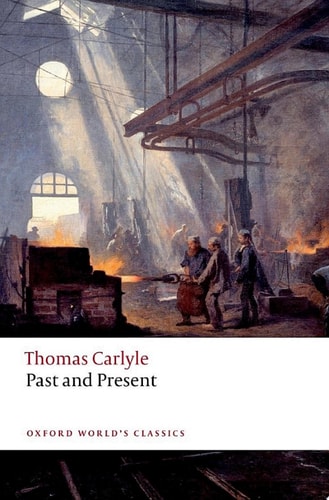
Past and Present
0
0
As an Amazon Associate and affiliate partner, Menrva Books earns from qualifying purchases. Learn more
Author Description
Thomas Carlyle's Past and Present (1843) was a prophetic warning of impending disaster for mid-Victorian Britain that was delivered in what the author described as a 'miraculous thunder-voice, from out of the centre of the world.' The impact of Carlyle's social criticism was immediate and profound, shaping debate about the 'The Condition of England' question well into the twentieth century and beyond, and serving as the moral foundation of the welfare state. His relentlessly abrasive and illuminating critique of industrial civilization generated a vast range of response both in England, Europe, and the United States. The writings of Matthew Arnold, John Stuart Mill, William Morris, John Henry Newman, and John Ruskin, as well as Henry David Thoreau, Ralph Waldo Emerson, and Walt Whitman, were saturated with imagery and ideas directly indebted to the book. Past and Present also provided novelists and poets with an enduring vision of the ubiquitous rot that lay at the heart of 'laissez-faire' England. The repercussions of Carlyle's unique analysis can be witnessed in the literary form and thematic content of such works as Charles Dickens's Christmas Carol (1843), Dombey and Son (1848), Bleak House (1852-53), and Hard Times (1854); Benjamin Disraeli's Sybil (1845); Elizabeth Gaskell's Mary Barton (1848) and North and South (1855); and Charles Kingsley's Alton Locke (1850). Poets such as Alfred Tennyson in Maud (1855), Elizabeth Barrett Browning in Aurora Leigh (1856), and Arthur Hugh Clough in The Latest Decalogue (1862) built a vocabulary that was steeped in the outrage and indignation of Carlyle's polemic. The artist Ford Madox Brown attempted in his painting Work (1852-65) to give visual testimony to the profound social schisms that Carlyle had exposed in Past and Present and to pay tribute to the 'Sage' who had 'moulded a nation to his pattern.'
Menrva's Summary
THE THESIS
Thomas Carlyle investigates the moral and social decay of mid-Victorian Britain, questioning whether industrial civilization can survive without a return to spiritual and communal values. Carlyle, a prominent Victorian essayist and historian, utilizes a blend of historical analogy and polemical rhetoric to argue that the 'laissez-faire' economic model has alienated the working class and eroded the national character. He posits that the solution lies in the leadership of a 'heroic' class and a renewed commitment to social duty over individual profit.
THE SCOPE MAP
What You Will Find
- A comparative analysis between 12th-century monastic life and 19th-century industrial society.
- A critique of the 'Condition of England' question regarding poverty and labor.
- Rhetorical arguments against utilitarianism and unchecked capitalism.
Scope Limits
- The text does not provide empirical economic data or statistical analysis of the era.
- It does not offer a systematic legislative policy for reform, focusing instead on moral and cultural transformation.
THE AUTHORITY PERSPECTIVE
Scholars and historians recognize this work as a foundational text that influenced the development of the British welfare state and the social consciousness of the Victorian era. Readers frequently note the dense, idiosyncratic, and highly stylized prose that characterizes Carlyle's unique polemical voice.
Page Count:
336
Publication Date:
2023-01-01
Publisher:
OUP Oxford
ISBN-10:
0192577840
ISBN-13:
9780192577849
Non-Fiction
Philosophy
History
Victorian History
Industrial history
Political Philosophy
Modern History