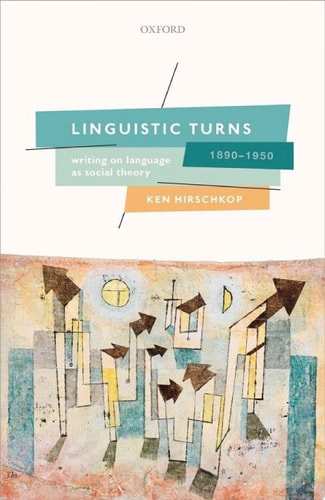
Linguistic Turns, 1890-1950: Writing on Language as Social Theory
0
0
As an Amazon Associate and affiliate partner, Menrva Books earns from qualifying purchases. Learn more
Author Description
Linguistic Turns rewrites the intellectual and cultural history of early twentieth-century Europe. In chapters that study the work of Saussure, Russell, Wittgenstein, Bakhtin, Benjamin, Cassirer, Shklovskii, the Russian Futurists, Ogden and Richards, Sorel, Gramsci, and others, it shows how European intellectuals came to invest 'language' with extraordinary force, at a time when the social and political order of the continent was itself in question. By examining linguistic turns in concert rather than in isolation, the volume changes the way we see them—no longer simply as moves in individual disciplines, but as elements of a larger constellation, held together by common concerns and anxieties. In a series of detailed readings, the volume reveals how each linguistic turn invested 'language as such' with powers that could redeem not just individual disciplines but Europe itself. It shows how, in the hands of different writers, language becomes a model of social and political order, a tool guaranteeing analytical precision, a vehicle of dynamic change, a storehouse of mythical collective energy, a template for civil society, and an image of justice itself. By detailing the force linguistic turns attribute to language, and the way in which they contrast 'language as such' with actual language, the volume dissects the investments made in words and sentences and the visions behind them. The constellation of linguistic turns is explored as an intellectual event in its own right and as the pursuit of social theory by other means.
Menrva's Summary
THE THESIS
This volume investigates how European intellectuals between 1890 and 1950 elevated the concept of language to a central position in social and political theory. Ken Hirschkop, a scholar of intellectual history, analyzes the works of diverse thinkers to demonstrate that the focus on language was not merely a disciplinary shift but a collective response to the instability of the European social order. The book argues that these linguistic turns functioned as a form of social theory, where language was reimagined as a model for justice, political organization, and cultural redemption.
THE SCOPE MAP
What You Will Find
- Comparative analysis of linguistic theories from Saussure, Wittgenstein, Bakhtin, Gramsci, and others.
- Examination of the intersection between linguistic philosophy and early 20th-century political crises.
- Analysis of language as a surrogate for social and political order.
Scope Limits
- The study is geographically confined to European intellectual traditions.
- The analysis focuses specifically on the period between 1890 and 1950.
THE AUTHORITY PERSPECTIVE
Scholars recognize this work as a significant contribution to the history of ideas, noting its ability to synthesize disparate intellectual movements into a coherent historical event. Readers frequently highlight the academic density of the prose, which requires a strong background in 20th-century philosophy to fully appreciate the author's arguments.
Page Count:
337
Publication Date:
2019-01-01
Publisher:
OUP Oxford
ISBN-10:
0192574620
ISBN-13:
9780192574626
History
Philosophy
Social Theory
Intellectual History
Indigenous
European History
Linguistics
Community Tags
Similar Books