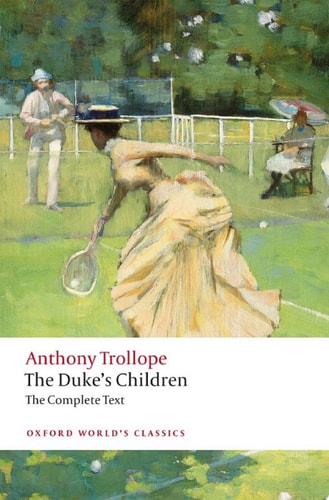
The Duke's Children
0
0
As an Amazon Associate and affiliate partner, Menrva Books earns from qualifying purchases. Learn more
Author Description
He was alone in the world, and there was no one of whom he could ask a question. After the sudden death of his wife, two years after he has left office as Prime Minister, the Duke of Omnium must become deeply involved with his children for the first time. They vex him enormously: with school expulsions, vast gambling debts, and what he considers to be calamitous romantic attachments. He tries to compel them to do what he wants, but they are not so easy to manage. Even when his eldest child and heir, Lord Silverbridge, makes him proud by embarking upon a political career, the Duke grapples with heartache. For Silverbridge becomes a Conservative rather than a Liberal, flouting the family tradition. The relationship between father and son is drawn with remarkable subtlety, and the book as a whole becomes a piercing, yet often humorous, exploration of change: how both the young and the old resist, tolerate, or embrace it. Trollope cut roughly 65,000 words, at a vulnerable moment in his career, to get the novel published, but concluded rapidly that he had made a grievous error. After a painstaking reconstruction by a team of researchers, The Duke's Children, the final book in Trollope's famed Palliser series, can now be read the way he first intended. It is a masterpiece of Victorian fiction.
Menrva's Summary
THE PULSE
Following the death of his wife, the Duke of Omnium struggles to navigate the complex lives of his children while reconciling his rigid expectations with their modern choices.
As a widower and former Prime Minister, the Duke attempts to exert control over his children’s personal and professional lives, only to find them resistant to his traditional values. The narrative follows the friction between the Duke’s desire for familial order and the independent paths taken by his heirs, particularly his son Lord Silverbridge. The story utilizes a third-person omniscient perspective to examine the generational divide within the British aristocracy. The world is defined by the strict social codes and political expectations of the Victorian era, which serve as the primary logical constraints for the characters' actions.
INSIDE THE PAGES
- Exploration of the generational divide in Victorian society
- Detailed examination of political party shifts and family legacy
- Focus on the internal conflict of a patriarch facing personal loss
- Realistic dialogue reflecting 19th-century social etiquette
- Analysis of the tension between parental authority and individual autonomy
- Inclusion of previously excised material restoring the author's original intent
- Satirical observations on the behavior of the British upper class
- Multi-layered character development across the Palliser family
THE COLLECTIVE ECHO
Readers and critics frequently highlight the psychological depth Trollope brings to the relationship between the Duke and his children. Discussion often centers on the novel's effectiveness in portraying the transition from traditional Victorian values to a more modern, individualistic outlook. Many observers appreciate the restoration of the original text, noting that the additional length provides necessary context for the characters' motivations. The pacing is described as deliberate, allowing for a thorough examination of social and political themes without sacrificing character nuance. Readers often find the Duke’s internal struggle to be a compelling study of human resistance to inevitable change.
Page Count:
737
Publication Date:
2020-01-01
Publisher:
OUP Oxford
ISBN-10:
0192572814
ISBN-13:
9780192572813
English
Political fiction
Victorian
Family Saga
English & College Success
Classic Literature
English literature
Social Commentary
Community Tags
Other Editions(35)

Creative Media Partners, LLC
2022
Default edition
Independently Published
2021

Independently Published
2021
Independently Published
2021

Independently Published
2020
Oxford University Press
2020
OUP Oxford
2020

Independently Published
2019

Independently Published
2019
Amazon Digital Services LLC - KDP Print US
2019

Independently Published
2019
Independently Published
2019

Independently Published
2019

Amazon Digital Services LLC - KDP Print US
2019
Amazon Digital Services LLC - KDP Print US
2019

Amazon Digital Services LLC - KDP Print US
2018

CreateSpace Independent Publishing Platform
2018

CreateSpace Independent Publishing Platform
2018

CreateSpace Independent Publishing Platform
2017

CreateSpace Independent Publishing Platform
2015

CreateSpace Independent Publishing Platform
2015

CreateSpace Independent Publishing Platform
2015

CreateSpace Independent Publishing Platform
2014

Cambridge Scholars Publishing
2012

OUP Oxford
2011
Roberts Press
2009

Oxford University Press
2008

Echo Library
2006

eBooksLib
2005

EBooksLib
2004

NuVision Publications
2004

Oxford University Press
1991
Oxford University Press
1985
Oxford University Press
1984
Oxford University Press
1973
Similar Books






Reader Comments
Share Your Thoughts
No comments yet. Be the first to share your thoughts!