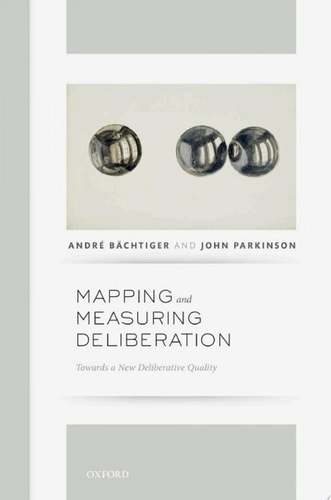
Mapping and Measuring Deliberation: Towards a New Deliberative Quality
0
0
As an Amazon Associate and affiliate partner, Menrva Books earns from qualifying purchases. Learn more
Author Description
Deliberative democracy has challenged two widely-accepted nostrums about democratic politics: that people lack the capacities for effective self-government; and that democratic procedures are arbitrary and do not reflect popular will; indeed, that the idea of popular will is itself illusory. On the contrary, deliberative democrats have shown that people are capable of being sophisticated, creative problem solvers, given the right opportunities in the right kinds of democratic institutions. But deliberative empirical research has its own problems. In this book two leading deliberative scholars review decades of that research and reveal three important issues. First, the concept 'deliberation' has been inflated so much as to lose empirical bite; second, deliberation has been equated with entire processes of which it is just one feature; and third, such processes are confused with democracy in a deliberative mode more generally. In other words, studies frequently apply micro-level tools and concepts to make macro- and meso-level judgements, and vice versa. Instead, Bächtiger and Parkinson argue that deliberation must be understood as contingent, performative, and distributed. They argue that deliberation needs to be disentangled from other communicative modes; that appropriate tools need to be deployed at the right level of analysis; and that scholars need to be clear about whether they are making additive judgements or summative ones. They then apply that understanding to set out a new agenda and new empirical tools for deliberative empirical scholarship at the micro, meso, and macro levels.
Menrva's Summary
THE THESIS
This book investigates the conceptual and methodological inconsistencies in empirical deliberative research to propose a more rigorous framework for measuring deliberative quality. André Bächtiger and John M. Parkinson, both established scholars in the field of deliberative democracy, synthesize decades of existing research to identify systemic flaws in how deliberation is defined and analyzed. They argue that current scholarship suffers from conceptual inflation and a failure to distinguish between micro, meso, and macro levels of analysis, ultimately presenting a new agenda for future empirical study.
THE SCOPE MAP
What You Will Find
- A critique of current deliberative democracy research methodologies.
- A framework for understanding deliberation as a contingent, performative, and distributed phenomenon.
- New empirical tools for analyzing deliberative quality across different institutional scales.
Scope Limits
- The text focuses primarily on political science methodology rather than providing a general history of democratic movements.
- It does not offer a comprehensive guide to implementing deliberative forums in local government.
THE AUTHORITY PERSPECTIVE
Experts in political science recognize this work as a significant intervention in the study of deliberative democracy. Readers frequently note the academic density of the prose, which is intended for researchers and advanced students of political theory.
Page Count:
203
Publication Date:
2018-01-01
Publisher:
OUP Oxford
ISBN-10:
0192571036
ISBN-13:
9780192571038
Sociology
Democracy
Political Theory
Community Tags
Similar Books