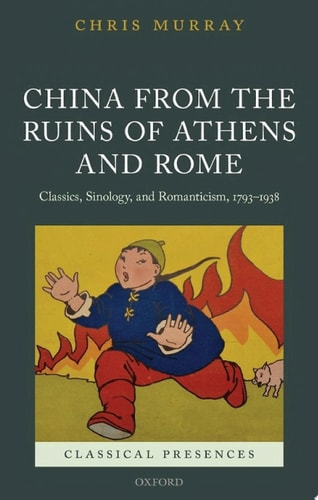
China from the Ruins of Athens and Rome: Classics, Sinology, and Romanticism, 1793-1938
0
0
As an Amazon Associate and affiliate partner, Menrva Books earns from qualifying purchases. Learn more
Author Description
Fascinated and often baffled by China, Anglophone writers turned to classics for answers. In poetry, essays, and travel narratives, ancient Greece and Rome lent interpretative paradigms and narrative shape to Britain's information on the Middle Kingdom. While memoirists of the diplomatic missions in 1793 and 1816 used classical ideas to introduce Chinese concepts, Roman history held ominous precedents for Sino-British relations according to Edward Gibbon and Samuel Taylor Coleridge. John Keats illuminated how peculiar such contemporary processes of Orientalist knowledge-formation were. In Britain, popular opinion on Chinese culture wavered during the nineteenth century, as Charles Lamb and Joanna Baillie demonstrated in ekphrastic responses to chinoiserie. A former reverence for China yielded gradually to hostility, and the classical inheritance informed a national identity-crisis over whether Britain's treatment of China was civilized or barbaric. Amidst this uncertainty, the melancholy conclusion to Virgil's Aeneid became the master-text for discussion of British conduct at the Summer Palace in 1860. Yet if Rome was to be the model for the British Empire, Tennyson, Sara Coleridge, and Thomas de Quincey found closer analogues for the Opium Wars in Greek tragedy and Homeric epic. Meanwhile, Sinology advanced considerably during the Victorian age. Britain broadened its horizons by interrogating the cultural past anew as it turned to Asia; Anglophone readers were cosmopolitans in time as well as space, aggregating knowledge of Periclean Athens, imperial Rome, and many other polities in their encounters with Qing Dynasty China.
Menrva's Summary
THE THESIS
This work investigates how Anglophone writers between 1793 and 1938 utilized the intellectual frameworks of classical Greece and Rome to interpret, categorize, and critique their encounters with China. Chris Murray, a scholar of classical reception, synthesizes literary analysis with historical inquiry to demonstrate how the British Empire relied on ancient paradigms to navigate the complexities of Sino-British relations. By examining poetry, essays, and travel narratives, the author argues that the classical tradition provided a vital, albeit often distorting, lens through which Victorian and post-Victorian thinkers processed the rise and fall of the Qing Dynasty.
THE SCOPE MAP
What You Will Find
- An analysis of classical allusions in the works of Keats, Coleridge, Tennyson, and De Quincey.
- A historical examination of the 1793 and 1816 diplomatic missions to China.
- An exploration of how the Aeneid and Homeric epics were used to justify or condemn British imperial conduct.
- A study of the intersection between emerging Sinology and established classical education in Britain.
Scope Limits
- The analysis is primarily restricted to Anglophone literary and intellectual responses rather than Chinese internal perspectives.
- The study focuses on the period between 1793 and 1938, excluding contemporary post-colonial developments.
THE AUTHORITY PERSPECTIVE
Scholars in the field of classical reception studies identify this text as a rigorous examination of how antiquity shaped modern imperial identity. Readers frequently note the academic density of the prose and the author's meticulous attention to the evolution of nineteenth-century Orientalist thought.
Page Count:
277
Publication Date:
2020-01-01
Publisher:
OUP Oxford
ISBN-10:
019107974X
ISBN-13:
9780191079740
History
19th Century
Cultural History
Indigenous
English literature
British literature
Sinology
Literary Criticism
Community Tags
Similar Books