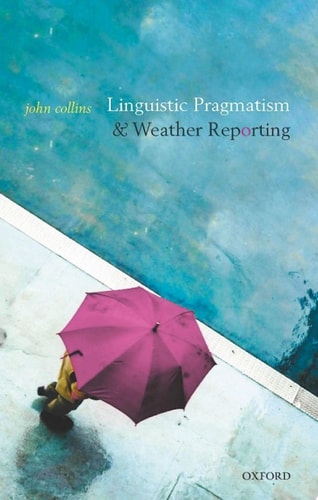
Linguistic Pragmatism and Weather Reporting
0
0
As an Amazon Associate and affiliate partner, Menrva Books earns from qualifying purchases. Learn more
Author Description
Linguistic pragmatism claims that what we literally say goes characteristically beyond what the linguistic properties themselves mandate. In this book, John Collins provides a novel defence of this doctrine, arguing that linguistic meaning alone fails to fix truth conditions. While this position is supported by a range of theorists, Collins shows that it naturally follows from a syntactic thesis concerning the relative sparseness of what language alone can provide to semantic interpretation. Language-and by extension meaning-provides constraints upon what a speaker can literally say, but does not characteristically encode any definite thing to say. Collins then defends this doctrine against a range of alternatives and objections, focusing in particular on an analysis of weather reports: 'it is raining/snowing/sunny'. Such reporting is mostly location-sensitive in the sense that the utterance is true or not depending upon whether it is raining/snowing/sunny at the location of the utterance, rather than some other location. Collins offers a full analysis of the syntax, semantics, and pragmatics of weather reports, including many novel data. He shows that the constructions lack the linguistic resources to support the common literal locative readings. Other related phenomena are discussed such as the Saxon genitive, colour predication, quantifier domain restriction, and object deletion.
Menrva's Summary
THE THESIS
This book investigates the core question of whether linguistic meaning alone is sufficient to determine truth conditions in human communication. John Collins, a philosopher of language, argues that literal speech consistently exceeds the constraints provided by linguistic properties. By utilizing a syntactic thesis regarding the sparseness of language, the author demonstrates that meaning functions as a set of constraints rather than an encoding of definite content, ultimately supporting the doctrine of linguistic pragmatism.
THE SCOPE MAP
What You Will Find
- A detailed syntactic and semantic analysis of weather report constructions such as 'it is raining'.
- Theoretical arguments regarding the Saxon genitive, colour predication, and quantifier domain restriction.
- A defense of linguistic pragmatism against competing semantic theories.
Scope Limits
- The text does not provide a comprehensive history of pragmatics as a field.
- The analysis focuses primarily on specific linguistic phenomena rather than broad sociolinguistic applications.
THE AUTHORITY PERSPECTIVE
Experts in the philosophy of language recognize this work as a rigorous contribution to the debate over semantic under-determination. Readers frequently note the technical density of the prose, which requires a strong background in formal semantics and syntactic theory to fully grasp the author's arguments.
Page Count:
240
Publication Date:
2020-01-01
Publisher:
OUP Oxford
ISBN-10:
0192591800
ISBN-13:
9780192591807
Philosophy
Semantics
Philosophy of
Linguistics
Syntax
Weather
Pragmatics
Community Tags
Similar Books