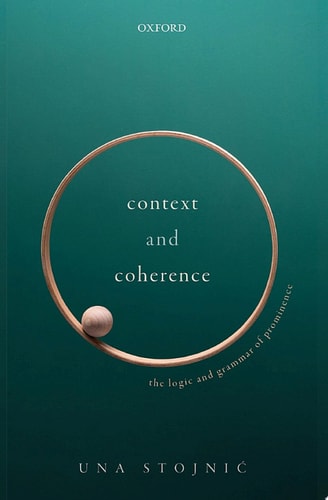
Context and Coherence: The Logic and Grammar of Prominence
0
0
As an Amazon Associate and affiliate partner, Menrva Books earns from qualifying purchases. Learn more
Author Description
Natural languages are riddled with context-sensitivity. One and the same string of words can express many different meanings on occasion of use, and yet we understand one another effortlessly, on the fly. How do we do so? What fixes the meaning of context-sensitive expressions, and how are we able to recover the meaning so effortlessly? This book offers a novel response: we can do so because we draw on a broad array of subtle linguistic conventions that determine the interpretation of context-sensitive items. Contrary to the dominant tradition, which maintains that the meaning of context-sensitive language is underspecified by grammar and that interpretation relies on non-linguistic cues and speakers' intentions, this book argues that meaning is determined entirely by discourse conventions, rules of language that have largely been missed and the effects of which have been mistaken for extra-linguistic effects of an utterance situation on meaning. The linguistic account of context developed here sheds a new light on the nature of linguistic content and the interaction between content and context. At the same time, it provides a novel model of context that should constrain and help evaluate debates across many subfields of philosophy where appeal to context has been common, often leading to surprising conclusions such as epistemology, ethics, value theory, metaphysics, metaethics, and logic.
Menrva's Summary
THE THESIS
This book investigates how speakers effortlessly interpret context-sensitive language by arguing that meaning is governed by systematic discourse conventions rather than non-linguistic cues. Una Stojnić, a philosopher specializing in the philosophy of language and mind, challenges the dominant view that context-sensitivity is underspecified by grammar. She proposes a formal linguistic framework that treats discourse rules as the primary mechanism for resolving ambiguity, thereby reclassifying effects previously attributed to extra-linguistic situational factors as products of linguistic structure.
THE SCOPE MAP
What You Will Find
- A formal model of discourse dynamics and context-sensitivity
- Analysis of linguistic conventions governing pronoun resolution and indexicals
- Applications of the framework to epistemology, ethics, and metaphysics
Scope Limits
- The text does not provide a comprehensive survey of all pragmatic theories
- It focuses primarily on formal semantic and syntactic structures rather than sociolinguistic variations
THE AUTHORITY PERSPECTIVE
Experts recognize this work as a significant contribution to formal semantics and the philosophy of language. Readers frequently note the technical density of the prose, which requires a strong background in logic and linguistic theory to fully grasp the proposed model.
Page Count:
229
Publication Date:
2021-01-01
Publisher:
OUP Oxford
ISBN-10:
0192634836
ISBN-13:
9780192634832
Philosophy
Linguistics
Semantics
Pragmatics
Context Linguistics
Philosophy of
Community Tags
Similar Books