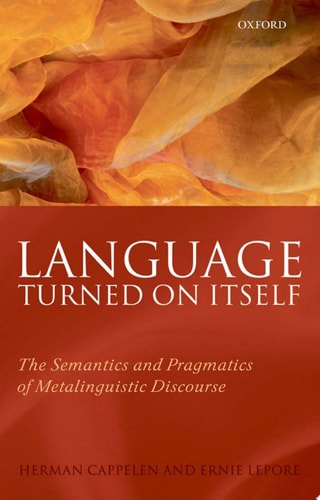
Language Turned on Itself: The Semantics and Pragmatics of Metalinguistic Discourse
0
0
As an Amazon Associate and affiliate partner, Menrva Books earns from qualifying purchases. Learn more
Author Description
Language Turned on Itself examines what happens when language becomes self-reflexive; when language is used to talk about language. Those who think, talk, and write about language are habitual users of various metalinguistic devices, but reliance on these devices begins early: kids are told, 'That's called a "rabbit"'. It's not implausible that a primitive capacity for the meta-linguistic kicks in at the beginning stages of language acquisition. But no matter when or how frequently these devices are invoked, one thing is clear: they present theorists of language with a complex data pattern. Herman Cappelen and Ernest Lepore show that the study of these devices and patterns not only represents an interesting and neglected project in the philosophy of language, but also carries important consequences for other parts of philosophy. Part I is devoted to presenting data about various aspects of our metalinguistic practices. In Part II, the authors examine and reject the four leading metalinguistic theories, and offer a new account of our use of quotation in a variety of different contexts. But the primary goal of this book is not to promote one theory over another. Rather, it is to present a deeply puzzling set of problems and explain their significance
Menrva's Summary
THE THESIS
This book investigates the complex semantic and pragmatic mechanisms that allow language to function as a tool for describing itself. Authors Ernest Lepore and Herman Cappelen, both established scholars in the philosophy of language, utilize a systematic analysis of metalinguistic devices to challenge existing theoretical frameworks. They argue that the reflexive nature of language is not merely a linguistic curiosity but a fundamental problem with significant implications for broader philosophical inquiry.
THE SCOPE MAP
What You Will Find
- Analysis of metalinguistic devices used in everyday discourse and language acquisition
- A critical review of four dominant theories regarding quotation and self-reference
- A proposed new account for interpreting quotation across diverse contexts
Scope Limits
- The text does not provide an exhaustive history of linguistic philosophy
- It does not focus on computational linguistics or formal logic systems outside of philosophical application
THE AUTHORITY PERSPECTIVE
Experts in the field recognize this work as a rigorous examination of the challenges posed by metalinguistic discourse. Readers frequently note the technical density of the prose, which is intended for an audience familiar with contemporary analytic philosophy.
Page Count:
148
Publication Date:
2007-01-01
Publisher:
Oxford University Press
ISBN-10:
0191528234
ISBN-13:
9780191528231
Philosophy
Metalanguage
Pragmatics
Semantics
Linguistics
Philosophy of
Community Tags
Other Editions(2)

Similar Books