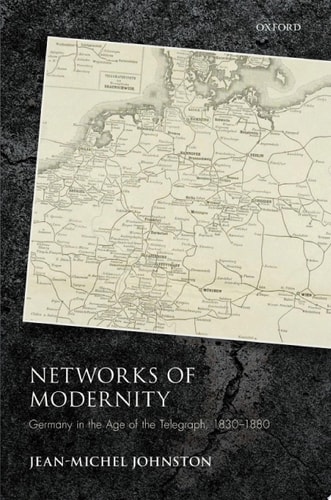
Networks of Modernity: Germany in the Age of the Telegraph, 1830-1880
0
0
As an Amazon Associate and affiliate partner, Menrva Books earns from qualifying purchases. Learn more
Author Description
This is an open access title available under the terms of a CC BY-NC-ND 4.0 International licence. It is free to read at Oxford Scholarship Online and offered as a free PDF download from OUP and selected open access locations. Networks of Modernity: Germany in the Age of the Telegraph, 1830-1880 offers a fresh perspective on the history of Germany by investigating the origins and impact of the 'communications revolution' that transformed state and society during the nineteenth century. It focuses upon the period 1830-1880, exploring the interactions between the many different actors who developed, administered, and used one of the most important technologies of the period-the electric telegraph. It reveals the channels through which scientific and technical knowledge circulated across Central Europe during the 1830s and 1840s, stimulating both collaboration and confrontation between the scientists, technicians, businessmen, and bureaucrats involved in bringing the telegraph to life. It highlights the technology's impact upon the conduct of trade, finance, news distribution, and government in the tumultuous decades that witnessed the 1848 revolutions, the wars of unification, and the establishment of the Kaiserreich in 1871. Following the telegraph lines themselves, it weaves together the changes which took place at a local, regional, national, and eventually global level, revisiting the technology's impact upon concepts of space and time, and highlighting the importance of this period in laying the foundations for Germany's experience of a profoundly ambiguous, networked modernity.
Menrva's Summary
THE THESIS
How did the introduction of the electric telegraph fundamentally reshape the political, economic, and social structures of nineteenth-century Germany? Jean-Michel Johnston, a historian specializing in the intersection of technology and statecraft, utilizes archival records and technical correspondence to argue that the telegraph was not merely a tool of communication but a catalyst for a new, networked form of modernity. The book posits that the development of telegraphic infrastructure facilitated a shift in how space and time were conceptualized, directly influencing the consolidation of the German state during a period of intense political volatility.
THE SCOPE MAP
What You Will Find
- Analysis of the 1830-1880 period, covering the transition from early experimentation to the establishment of the Kaiserreich.
- Examination of the collaborative and competitive relationships between scientists, bureaucrats, and private enterprise.
- Investigation into the impact of telegraphy on trade, finance, and the distribution of news during the 1848 revolutions and wars of unification.
Scope Limits
- The study focuses primarily on the German-speaking lands of Central Europe and does not provide a comprehensive global history of telegraphy.
- The analysis prioritizes the institutional and social history of the technology over a detailed technical manual of telegraphic hardware.
THE AUTHORITY PERSPECTIVE
Scholars in the field of German history and media studies recognize this work as a rigorous examination of how infrastructure projects influence national identity and state power. Readers frequently note the academic density of the prose, which provides a detailed look at the bureaucratic and scientific networks that defined the era.
Page Count:
295
Publication Date:
2021-01-01
Publisher:
OUP Oxford
ISBN-10:
0192598945
ISBN-13:
9780192598943
History
Technology history
19th Century
Sociology
Modern History
German history
Communication Studies