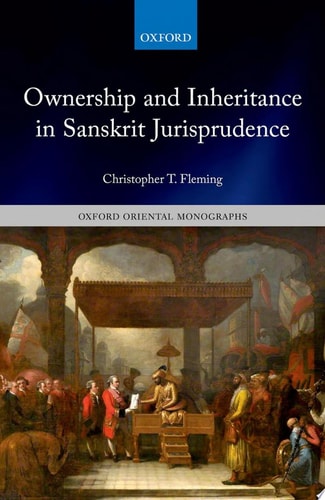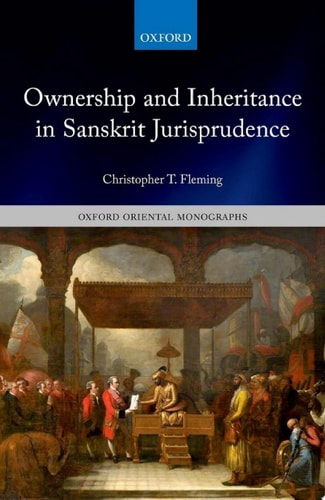
Ownership and Inheritance in Sanskrit Jurisprudence
0
0
As an Amazon Associate and affiliate partner, Menrva Books earns from qualifying purchases. Learn more
Author Description
Ownership and Inheritance in Sanskrit Jurisprudence provides an account of various theories of ownership (svatva) and inheritance (dāya) in Sanskrit jurisprudential literature (Dharmaśāstra). It examines the evolution of different juridical models of inheritance--in which families held property in trusts or in tenancies-in-common--against the backdrop of related developments in the philosophical understanding of ownership in the Sanskrit text-traditions of hermeneutics (Mīmāṃsā) and logic (Nyāya) respectively. Christopher T. Fleming reconstructs medieval Sanskrit theories of property and traces the emergence of various competing schools of Sanskrit jurisprudence during the early modern period (roughly fifteenth-nineteenth centuries) in Bihar, Bengal, and Varanasi. Fleming attends to the ways in which ideas from these schools of jurisprudence shaped the codification of Anglo-Hindu personal law by administrators of the British East India Company during the late eighteenth and early nineteenth centuries. While acknowledging the limitations of colonial conceptions of Dharmaśāstra as positive law, this study argues for far greater continuity between pre-colonial and colonial Sanskrit jurisprudence than accepted previously. It charts the transformation of the Hindu law of inheritance--through precedent and statute--over the late nineteenth, twentieth, and early twenty-first centuries.
Menrva's Summary
THE THESIS
This study investigates the evolution of ownership (svatva) and inheritance (dāya) theories within Sanskrit jurisprudential literature and their subsequent impact on the development of Anglo-Hindu personal law. Christopher T. Fleming utilizes a rigorous analysis of Dharmaśāstra texts, integrating philosophical insights from Mīmāṃsā hermeneutics and Nyāya logic. By reconstructing medieval theories of property, the author demonstrates the continuity between pre-colonial legal frameworks and the administrative codifications enacted by the British East India Company. The work challenges established narratives regarding the rupture between traditional Sanskrit jurisprudence and colonial legal systems.
THE SCOPE MAP
What You Will Find
- Analysis of svatva and dāya theories in medieval Sanskrit texts.
- Examination of property models including family trusts and tenancies-in-common.
- Historical tracing of legal schools in Bihar, Bengal, and Varanasi from the fifteenth to the nineteenth centuries.
- Assessment of the influence of Sanskrit jurisprudence on British colonial legal administration.
Scope Limits
- The study does not provide an exhaustive survey of all regional variations of Hindu law outside the specified geographic focus.
- It does not offer a comprehensive legal manual for modern practice but focuses on historical and theoretical evolution.
THE AUTHORITY PERSPECTIVE
Scholars in the field of South Asian legal history recognize this work as a significant contribution to the understanding of pre-colonial jurisprudential continuity. Readers frequently note the academic density of the prose and the author's meticulous engagement with primary Sanskrit sources.
Page Count:
268
Publication Date:
2020-01-01
Publisher:
OUP Oxford
ISBN-10:
0192593544
ISBN-13:
9780192593542
Religion
Philosophy
Asian History
Law india
Legal History
Hindu Law
Law
Dharmashastra