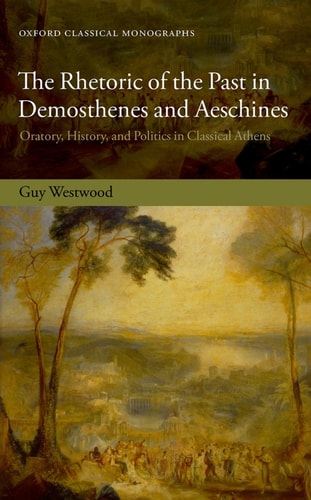
The Rhetoric of the Past in Demosthenes and Aeschines: Oratory, History, and Politics in Classical Athens
0
0
As an Amazon Associate and affiliate partner, Menrva Books earns from qualifying purchases. Learn more
Author Description
In democratic Athens, mass citizen audiences - whether in the lawcourts, or in the political Assembly and Council, or when gathered for formal civic occasions - frequently heard politicians and litigants discussing the city's past, and manipulating it for persuasive ends. The Rhetoric of the Past in Demosthenes and Aeschines explores how these dynamics worked in practice, taking two prominent mid-fourth-century politicians (and bitter adversaries) as focal points. While most recent scholarly treatments of how the Athenians recalled their past concentrate on collective processes, this work looks instead at the rhetorical strategies devised by individual orators, examining what it meant for Demosthenes or Aeschines to present particular 'historical' examples, arguments, and illustrations in particular contexts. It argues that discussing the Athenian past - and therefore discussing a core aspect of Athenian identity itself - offered Demosthenes and Aeschines, among others, an effective and versatile means both of building and highlighting their own credibility, authority, and commitment to the democracy and its values, and of competing with their rivals, whose own versions and handling of the past they could challenge and undermine as a symbolic attack on those rivals' wider competence. Recourse to versions of the past also offered orators a way of reflecting on a troubled contemporary geopolitical landscape in which Athens first confronted the enterprising Philip II of Macedon and then coped with Macedonian hegemony. The work covers the full range of Demosthenes' and Aeschines' surviving public speeches, and the extended opening chapter includes synoptic surveys of key individual topics which feed into the main discussion.
Menrva's Summary
THE THESIS
This work investigates how the manipulation of historical narrative served as a primary rhetorical tool for political persuasion and identity construction in fourth-century BCE Athens. Guy Westwood, a scholar of classical oratory, utilizes the surviving speeches of Demosthenes and Aeschines to demonstrate how these rivals weaponized the Athenian past to establish personal credibility and undermine their opponents. By analyzing these texts, the author argues that historical reference was not merely a decorative element but a functional mechanism for navigating the geopolitical pressures of the Macedonian era.
THE SCOPE MAP
What You Will Find
- Analysis of rhetorical strategies used by Demosthenes and Aeschines.
- Examination of the intersection between civic identity and historical memory.
- Synoptic surveys of key historical topics within the opening chapter.
- Contextualization of oratory within the Athenian Assembly and lawcourts.
Scope Limits
- The study focuses primarily on the surviving public speeches of two specific orators.
- It does not provide a comprehensive history of Athenian historiography outside of oratorical practice.
THE AUTHORITY PERSPECTIVE
Scholars recognize this monograph as a rigorous contribution to the study of Athenian political discourse and the mechanics of classical rhetoric. Readers frequently note the academic density of the prose, which is tailored for specialists in classical history and political theory.
Page Count:
423
Publication Date:
2020-01-01
Publisher:
OUP Oxford
ISBN-10:
0192599127
ISBN-13:
9780192599124
Philosophy
Biography
History
Rhetoric
Ancient Greece
History & Surveys
Community Tags
Similar Books