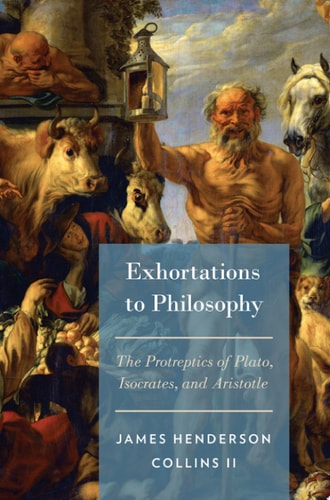
Exhortations to Philosophy: The Protreptics of Plato, Isocrates, and Aristotle
0
0
As an Amazon Associate and affiliate partner, Menrva Books earns from qualifying purchases. Learn more
Author Description
This book is a study of the literary strategies which the first professional philosophers used to market their respective disciplines. Philosophers of fourth-century BCE Athens developed the emerging genre of the "protreptic" (literally, "turning" or "converting"). Simply put, protreptic discourse uses a rhetoric of conversion that urges a young person to adopt a specific philosophy in order to live a good life. The author argues that the fourth-century philosophers used protreptic discourses to market philosophical practices and to define and legitimize a new cultural institution: the school of higher learning (the first in Western history). Specifically, the book investigates how competing educators in the fourth century produced protreptic discourses by borrowing and transforming traditional and contemporary "voices" in the cultural marketplace. They aimed to introduce and promote their new schools and define the new professionalized discipline of "philosophy." While scholars have typically examined the discourses and practices of Plato, Isocrates, and Aristotle in isolation from one another, this study rather combines philosophy, narratology, genre theory, and new historicism to focus on the discursive interaction between the three philosophers: each incorporates the discourse of his competitors into his protreptics. Appropriating and transforming the discourses of their competition, these intellectuals created literary texts that introduced their respective disciplines to potential students.
Menrva's Summary
THE THESIS
This book investigates how fourth-century BCE Athenian philosophers utilized the protreptic genre as a rhetorical tool to market their schools and legitimize the nascent institution of higher learning. James Henderson II Collins, a scholar of classical rhetoric and philosophy, employs a multidisciplinary framework that integrates narratology, genre theory, and new historicism. He argues that Plato, Isocrates, and Aristotle did not develop their philosophies in isolation, but rather engaged in a competitive discursive exchange where each philosopher appropriated and transformed the arguments of his rivals to define his own professional discipline.
THE SCOPE MAP
What You Will Find
- Analysis of the protreptic genre as a mechanism for philosophical conversion and institutional marketing.
- Comparative study of the rhetorical strategies employed by Plato, Isocrates, and Aristotle.
- Application of narratological and new historicist methodologies to classical philosophical texts.
Scope Limits
- The study focuses specifically on the fourth-century BCE Athenian context and does not extend to later Hellenistic or Roman developments of the genre.
- The analysis is restricted to the discursive interactions between these three specific figures rather than a comprehensive survey of all contemporary philosophical schools.
THE AUTHORITY PERSPECTIVE
Scholars in the field of classical studies recognize this work as a significant contribution to understanding the intersection of rhetoric and early institutional philosophy. Readers frequently note the academic density of the prose, which requires a foundational knowledge of both classical Greek history and literary theory to fully appreciate the author's arguments.
Page Count:
320
Publication Date:
2015-01-01
Publisher:
Oxford University Press
ISBN-10:
0190266546
ISBN-13:
9780190266547
Philosophy
History & Surveys
Education - History
Literary Criticism
Rhetoric
Community Tags
Similar Books