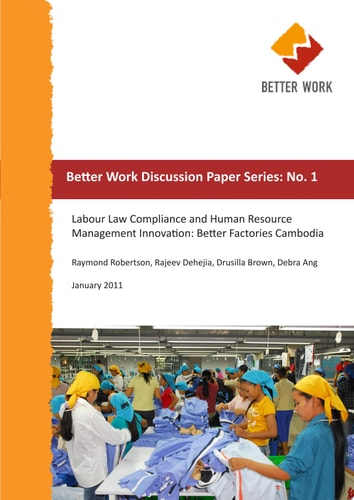
Labour Law Compliance and Human Resource Management Innovation: Better Factories Cambodia
0
0
As an Amazon Associate and affiliate partner, Menrva Books earns from qualifying purchases. Learn more
Author Description
Analyzing labour law compliance data in the apparel industry from Better Factories Cambodia, we find that (1) there was a broad improvement in working conditions among factories both with and without a reputation sensitive buyer, (2) factories with a reputation sensitive buyer have higher average compliance, (3) after the elimination of public disclosure of factory level noncompliance the rate of improved compliance slowed for factories with a reputation sensitive buyer and compliance declined for factories lacking a reputation sensitive buyer but (4) compliance did not return to the baseline even in the absence of a reputation sensitive buyer or threat of public disclosure of noncompliance. These findings are consistent with the hypotheses that (1) third party enforcement complements code compliance efforts by reputation sensitive buyers, (2) factory-specific public disclosure of noncompliance helps control free-riding of noncompliant factories lacking a reputation sensitive buyer on the market-level reputational externalities generated by compliant factories and that (3) enforcement activities induce factories to experiment in human resource management innovations that are both more humane and more efficient.
Menrva's Summary
THE THESIS
This study investigates the impact of buyer reputation and public disclosure on labor law compliance and human resource management innovation within Cambodia's apparel industry. The research analyzes data from Better Factories Cambodia, revealing a general improvement in working conditions across factories, with those having reputation-sensitive buyers showing higher average compliance. However, the study notes a slowdown in compliance improvement after the cessation of public disclosure, particularly for factories without such buyers, though compliance did not revert to baseline levels.
THE SCOPE MAP
- Analysis of labor law compliance data from Better Factories Cambodia.
- Examination of the role of reputation-sensitive buyers in improving compliance.
- Impact of public disclosure of factory-level noncompliance on compliance rates.
- Assessment of compliance trends before, during, and after public disclosure.
- Investigation into the relationship between third-party enforcement and code compliance.
- Exploration of how public disclosure controls free-riding by noncompliant factories.
- Hypotheses on how enforcement activities encourage human resource management innovations.
THE AUTHORITY PERSPECTIVE
The findings suggest that external pressures, such as buyer reputation and public disclosure, significantly influence labor law compliance in the apparel sector. The study posits that these external mechanisms, complemented by factory-level innovations in human resource management, contribute to both more humane and efficient working conditions. The research indicates that while compliance improves with external oversight, the sustained adoption of better practices may depend on a combination of these factors. The analysis provides insights into the effectiveness of different enforcement strategies in global supply chains.
Page Count:
22
Publication Date:
2011-01-01
Publisher:
Better Work (ILO/IFC)
ISBN-10:
9221245942
ISBN-13:
9789221245940
Business
Economics
Non-Fiction
International Development
Human Resource Management
Compliance
Community Tags
Similar Books