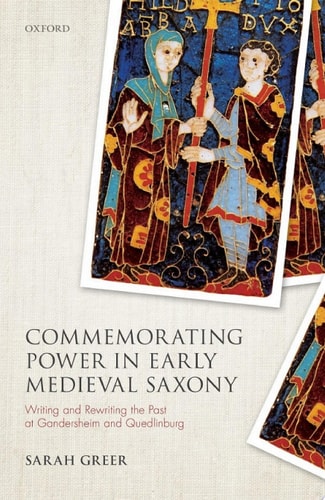
Commemorating Power in Early Medieval Saxony: Writing and Rewriting the Past at Gandersheim and Quedlinburg
0
0
As an Amazon Associate and affiliate partner, Menrva Books earns from qualifying purchases. Learn more
Author Description
In the early medieval world, the way people remembered the past changed how they saw the present. New accounts of former leaders and their deeds could strengthen their successors, establish novel claims to power, or criticize the current ruler. After 888, when the Carolingian Empire fractured into the smaller kingdoms of medieval western Europe, memory became a vital tool for those seeking to claim royal power for themselves. Commemorating Power in Early Medieval Saxony looks at how the past was evoked for political purposes under a new Saxon dynasty, the Ottonians, who came to dominate post-Carolingian Europe as the rulers of a new empire in Germany and Italy. With the accession of the first Ottonian king, Henry I, in 919, sites commemorating the king's family came to the foreground of the medieval German kingdom. The most remarkable of these were two convents of monastic women, Gandersheim and Quedlinburg, whose prominence and prestige in Ottonian politics have been seen as exceptional in the history of early medieval western Europe. In this volume, Sarah Greer offers a fresh interpretation of how these convents became central sites in the new Ottonian empire by revealing how the women in these communities themselves were skilful political actors who were more than capable of manipulating memory for their own benefit. In this first major study in English of how these Saxon convents functioned as memorial centres, Greer presents a new vision of the first German dynasty, one characterized by contingency, versatility, and the power of the past.
Menrva's Summary
THE THESIS
How did the manipulation of historical memory serve as a mechanism for political legitimacy and power consolidation within the Ottonian dynasty of early medieval Saxony? Sarah Greer, a scholar specializing in medieval history, utilizes primary source analysis of monastic records and hagiographies to argue that the convents of Gandersheim and Quedlinburg were not merely passive religious sites. Instead, she posits that the women residing in these communities acted as sophisticated political agents who actively curated and reshaped narratives of the past to bolster the authority of the Saxon rulers and their own institutional standing.
THE SCOPE MAP
What You Will Find
- Analysis of the Ottonian dynasty's political evolution following the collapse of the Carolingian Empire.
- Examination of the memorial functions of the Gandersheim and Quedlinburg convents.
- Methodology for interpreting medieval hagiography and commemorative texts as political instruments.
Scope Limits
- The study focuses specifically on the Saxon context and does not provide a comprehensive survey of all European monastic memorial practices.
- The analysis is restricted to the period surrounding the rise and consolidation of the Ottonian empire.
THE AUTHORITY PERSPECTIVE
Historians identify this work as a significant contribution to the study of Ottonian political culture and the agency of monastic women in the tenth and eleventh centuries. Scholars frequently note the clarity with which Greer connects local conventual practices to the broader geopolitical strategies of the German kingdom.
Page Count:
220
Publication Date:
2021-01-01
Publisher:
OUP Oxford
ISBN-10:
0192590413
ISBN-13:
9780192590411
History
Political History
Germany history
German history
European History
Monastic Studies