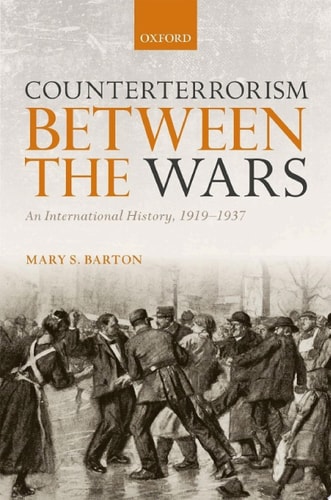
Counterterrorism Between the Wars: An International History, 1919-1937
0
0
As an Amazon Associate and affiliate partner, Menrva Books earns from qualifying purchases. Learn more
Author Description
Mary S. Barton explores counterterrorism in the years between World War I and World War II, starting with the attempted assassination of French Prime Minister George Clemenceau in 1919, and taking the story up to and beyond the double assassination of King Alexander I of Yugoslavia and French Foreign Minister Jean Louis Barthou in 1934. In telling the story of counterterrorism over this period, Barton gives particular emphasis to Britain's attempts to quell revolutionary nationalist movements in India and throughout its empire, and to the Great Powers' combined efforts to counter the activities of the Communist International. Further to this, Barton discusses the establishment of the tools and infrastructure of modern intelligence, including the cooperation between the United Kingdom and United States which would evolve into the Five Eyes intelligence alliance. She gives weight to forgotten terrorism and arms traffic conventions, and explores the facilitating role which the Paris Peace Conference and the League of Nations played in this context. The stories told in Counterterrorism Between the Wars play out across the world, from the remains of the Austro-Hungarian, German, and Russian empires, to the Northwest Frontier and the Bengal Province of British India. A century after the Paris Peace Conference of 1919, Counterterrorism Between the Wars is the first comprehensive study to fit together the mass production of weapons during the Great War with the diplomacy of the interwar era and the rise of state-sponsored terrorism during the 1920s and 1930s.
Menrva's Summary
THE THESIS
This work investigates the emergence and institutionalization of international counterterrorism strategies during the interwar period, specifically between 1919 and 1937. Mary S. Barton, a historian specializing in global security, utilizes archival research and diplomatic records to argue that the modern infrastructure of state intelligence was forged in response to revolutionary nationalism and the global spread of communism. She demonstrates how the post-World War I geopolitical landscape necessitated new forms of cross-border cooperation, effectively linking the surplus of weaponry from the Great War to the formalization of intelligence alliances.
THE SCOPE MAP
What You Will Find
- Analysis of the League of Nations and Paris Peace Conference as frameworks for security cooperation
- Examination of British colonial counter-insurgency efforts in India
- Documentation of the early cooperation between UK and US intelligence agencies
- Historical overview of arms traffic conventions and international treaties
Scope Limits
- The study focuses primarily on the activities of the Great Powers and does not provide an exhaustive account of every regional conflict during this era
- The narrative concludes shortly after 1934, leaving the full escalation into World War II outside the primary scope of this specific analysis
THE AUTHORITY PERSPECTIVE
Historians and security scholars recognize this text as a foundational study for understanding the origins of modern intelligence cooperation. Readers frequently note the academic density of the prose, which provides a rigorous examination of diplomatic history for those interested in the evolution of state-sponsored security measures.
Page Count:
222
Publication Date:
2020-01-01
Publisher:
OUP Oxford
ISBN-10:
0192609556
ISBN-13:
9780192609557
History
Modern History
Military History
International relations
20th Century
Community Tags
Similar Books