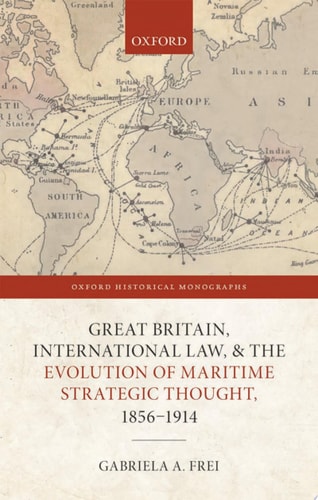
Great Britain, International Law, And The Evolution Of Maritime Strategic Thought, 1856-1914
0
0
As an Amazon Associate and affiliate partner, Menrva Books earns from qualifying purchases. Learn more
Author Description
Cover -- Great Britain, International Law, And The Evolution Of Maritime Strategic Thought, 1856-1914 -- Copyright -- Acknowledgements -- Contents -- Introduction -- 1: The Sea As A Legal And Strategic Space -- The Sea As A Legal Space -- Blockade And The Right Of Search And Capture -- The Rule Of 1756 -- Claims Of Neutrality -- The Sea As A Strategic Space -- The Protection Of Trade -- Economic Warfare And International Law -- Blockade -- Strategic Importance Of Foodstuffs -- Protection Of Trade As Strategic Importance -- 2: The Making Of The Neutrality Policy -- Early Concepts Of Neutrality The American Civil War: A Turning Point -- British Neutrality Policy -- The Foreign Enlistment Act Of 1870 -- 3: The Law Of Neutrality And State Practice -- The Shipbuilding Industry And The Sale Of Ships -- Coaling In Neutral Ports And International Waters -- Trade In Contraband Goods -- Coal -- Foodstuffs -- Arms And Ammunition -- Destruction Of Neutral Ships -- Britain's Experience Of Neutrality -- 4: The Codification Of International Maritime Law -- Governmental Action And The Brussels Declaration -- Non-governmental Action And The Process Of Codification The Institut De Droit International -- The Us Naval War Code -- 5: The Hague And London Conferences And The Rise Of An International Legal Order -- Preparations For The Second Hague Peace Conference -- The 1907 Hague Peace Conference -- The Aftermath Of The Hague Peace Conference -- The 1909 London Naval Conference -- The Aftermath Of The London Naval Conference -- 6: Maritime Strategic Thought And International Law -- Evolution Of Maritime Strategic Thought -- Effects Of International Law On British Maritime Strategy -- Makers Of Maritime Strategy International Law And British Maritime Strategy -- 7: International Law And The Theory Of War -- The Right Of Search And Capture -- The United States And The Immunity Of Private Property -- Britain And The Immunity Of Private Property -- The 1899 Hague Peace Conference -- Shifti
Menrva's Summary
THE THESIS
This work investigates the complex interplay between the development of international maritime law and the evolution of British naval strategic thought between 1856 and 1914. Gabriela A. Frei, a scholar specializing in international history, utilizes archival records and diplomatic correspondence to argue that legal frameworks were not merely constraints on naval power but were actively integrated into the strategic calculations of the British state. The book demonstrates how the shifting definitions of neutrality, blockade, and contraband directly influenced the Royal Navy's operational planning during the decades leading up to the First World War.
THE SCOPE MAP
What You Will Find
- Analysis of the 1856 Declaration of Paris and its impact on maritime warfare.
- Examination of the Hague and London Naval Conferences as forums for legal codification.
- Detailed study of British neutrality policies during the American Civil War and subsequent conflicts.
- Evaluation of how coal, foodstuffs, and shipbuilding influenced international legal debates.
Scope Limits
- The study concludes in 1914 and does not analyze the practical application of these legal theories during the naval campaigns of the First World War.
- The focus remains primarily on British perspectives and state practice rather than a comprehensive global history of maritime law.
THE AUTHORITY PERSPECTIVE
Historians and legal scholars frequently cite this work for its meticulous archival research and its ability to bridge the gap between legal history and strategic studies. Experts highlight the text as a significant contribution to understanding the intellectual foundations of British naval policy in the late nineteenth and early twentieth centuries.
Page Count:
272
Publication Date:
2020-01-01
Publisher:
Oxford University Press,
ISBN-10:
0192603809
ISBN-13:
9780192603807
History
Maritime history
Military Strategy
International Law
British History
Maritime law
Community Tags
Other Editions(2)
Similar Books








Reader Comments
Share Your Thoughts
No comments yet. Be the first to share your thoughts!