The Right to Exclude: A Critical Race Approach to Sovereignty, Borders, and International Law
0
0
As an Amazon Associate and affiliate partner, Menrva Books earns from qualifying purchases. Learn more
Author Description
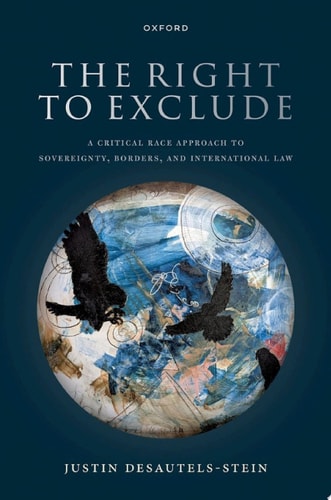
In a world in which racism and xenophobia are endemic, what is the role of international law? To the extent international rules are thought to have any relevance at all, the typical approach characterizes international law as on the side of racial justice. Human rights instruments like the United Nations' International Convention on the Elimination of Racial Discrimination are paradigmatic, offering the world international agreements in which governments are directed to avoid racist behavior and promote antiracist action. In The Right to Exclude, Justin Desautels-Stein goes against the grain and asks whether certain rules of international law might actually produce structures of racial hierarchy, rather than limiting them. The intellectual fulcrum for this production, Desautels-Stein argues, lies in the ideological structures of sovereignty and property, the right to exclude that is shared in those twinned precincts, and the border regimes that result. Applying critical race theory to contemporary problems of migration, nationalism, multiculturalism, decolonization, and self-determination, Desautels-Stein expounds a theory of "postracial xenophobia", a structure of racial ideology that justifies and legitimates a pragmatic account of racialized foreignness, a racial xenos.
Menrva's Summary
THE THESIS
This book investigates whether the foundational structures of international law, specifically sovereignty and property, actively produce racial hierarchies rather than mitigating them. Justin Desautels-Stein, a legal scholar, utilizes critical race theory to challenge the conventional view that international law serves as a neutral arbiter of racial justice. By examining the ideological intersections of border regimes and the right to exclude, the author argues that international legal frameworks often legitimize a form of 'postracial xenophobia' that sustains racialized foreignness.
THE SCOPE MAP
What You Will Find
- Analysis of the ideological link between sovereignty and property rights.
- Theoretical framework of 'postracial xenophobia' and the 'racial xenos'.
- Critical examination of international agreements like the International Convention on the Elimination of Racial Discrimination.
- Application of critical race theory to contemporary issues of nationalism, decolonization, and migration.
Scope Limits
- The text focuses primarily on the structural and ideological critique of international law rather than providing a comprehensive history of specific border policies.
- It does not offer a prescriptive policy manual for reforming international legal institutions.
THE AUTHORITY PERSPECTIVE
Legal scholars and critics identify this work as a significant contribution to the critical legal studies movement, particularly for its provocative re-evaluation of sovereignty. Readers frequently note the academic density of the prose, which is intended for an audience familiar with legal theory and critical race discourse.
Page Count:
363
Publication Date:
2023-01-01
Publisher:
OUP Oxford
ISBN-10:
0192606794
ISBN-13:
9780192606792
Human rights
Law
Professional Career & Trade
Migration Studies
Critical Theory
International Law
Sociology
Community Tags
Similar Books