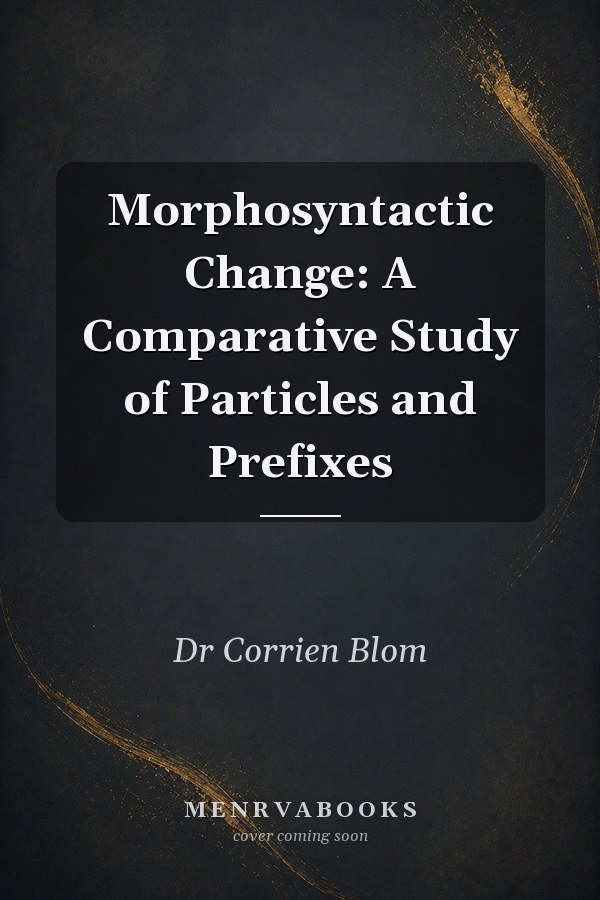
Morphosyntactic Change: A Comparative Study of Particles and Prefixes
0
0
As an Amazon Associate and affiliate partner, Menrva Books earns from qualifying purchases. Learn more
Author Description
Particle verbs (combinations of two words but lexical units) are a notorious problem in linguistics. Is a particle verb like look up one word or two? It has its own entry in dictionaries, as if it is one word, but look and up can be split up in a sentence: we can say He looked the information up and He looked up the information. But why can't we say He looked up it? In English look and up can only be separated by a direct object, but in Dutch the two parts can be separated over a much longer distance. How did such hybrid verbs arise and how do they function? How can we make sense of them in modern theories of language structure? This book sets out to answer these and other questions, explaining how these verbs fit into the grammatical systems of English and Dutch.
Menrva's Summary
THE THESIS
This book investigates the evolution of particle verbs and their morphosyntactic properties across English and Dutch. The authors, drawing on extensive data, analyze the compositionality and conventionality of these verb forms, offering insights into their diachronic and synchronic syntactic implications. The work addresses the fundamental question of whether particle verbs function as single lexical units or as combinations of words, exploring their unique grammatical behavior and their place within modern linguistic theory.
THE SCOPE MAP
- Analysis of particle verbs as lexical units versus word combinations.
- Exploration of the separation of particle and verb in English and Dutch.
- Comparison of particle verb behavior between English and Dutch.
- Explanation of the historical development of hybrid verbs.
- Implications for diachronic and synchronic syntactic theory.
- Discussion of compositionality and conventionality in particle verbs.
- Detailed data material from English and Dutch.
THE AUTHORITY PERSPECTIVE
Advance praise highlights the book's wealth of data and its coherent analysis of compositionality and conventionality, noting significant implications for syntactic theory. Scholars interested in comparative, synchronic, or diachronic studies of particles and prefixes are specifically recommended this work. The book is recognized for its contribution to understanding the complex nature of particle verbs.
Page Count:
1
Publication Date:
2012-05-05
Publisher:
Cambridge University Press
ISBN-10:
0511998449
ISBN-13:
9780511998447
Non-Fiction
Literary Fiction
Historical linguistics
Syntax
Linguistics
Comparative linguistics
Morphology
Community Tags
Similar Books