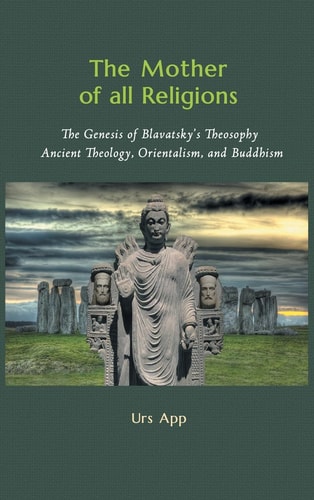
The Mother of All Religions: The Genesis of Blavatsky's Theosophy
0
0
As an Amazon Associate and affiliate partner, Menrva Books earns from qualifying purchases. Learn more
Author Description
The Story of Helena Blavatsky's Invention of Primeval Religion Helena Petrovna Blavatsky (1831-1891), the "grandmother of the New Age," not only inspired artists such as Kandinsky, Klee, Mondriaan, Scriabin, Mahler, Sibelius, T. S. Eliot and Kahlil Gibran but also founders of spiritual movements such as Rudolf Steiner and George Gurdjieff. In 1875 Blavatsky co-founded the Theosophical Society in New York, and in the remaining sixteen years of her life she authored all fundamental works of modern Theosophy. Already in her lifetime, her Society had hundreds of branches in India and all over the world, and even today sections and subsections of the movement are active in many countries of Asia and the West. Blavatsky is an extremely controversial figure. Hailed by some as the most extraordinary woman of the 19th century, she was denounced by others as history's greatest charlatan. Her central claims were that she enjoyed direct contact with members of an esoteric, Buddhism-associated brotherhood in Tibet who had initiated her to secret doctrines transmitted from the dawn of humanity, and that she had access to the world's most ancient religious scripture: the Book of Dzyan. Urs App, the author of The Birth of Orientalism (2010) & The Cult of Emptiness (2012), and editor of Blavatsky on Buddhism (2023), describes how Blavatsky-much inspired by Romantic orientalist views of Buddhism-invented the world's primeval wisdom religion. Instead of regarding Blavatsky as an adept with superior powers and an initiate of unchanging secret doctrines transmitted from remote antiquity, App studies her as one would any modern intellectual author by investigating the historical development of her thought. What did she read and when, what key ideas did she pick up from what sources, and how did she combine, digest, and transform such information into a Buddhism- and Orientalism-inspired Ancient Theology?
Menrva's Summary
THE THESIS
This book investigates the origins and intellectual construction of Helena Blavatsky's Theosophy, examining how she synthesized ancient theology, Orientalist perspectives, and Buddhist thought to create a primeval wisdom religion. Urs App, a scholar of Orientalism and religious history, analyzes Blavatsky not as a mystical adept but as a modern intellectual author. The study traces the historical development of her ideas, focusing on her reading habits and the sources from which she drew inspiration, particularly Romantic Orientalist views of Buddhism. App reconstructs how Blavatsky combined, digested, and transformed this information into her unique interpretation of ancient theology.
THE SCOPE MAP
- An examination of Helena Blavatsky's invention of Theosophy as a primeval wisdom religion.
- Analysis of Blavatsky's engagement with ancient theology, Orientalism, and Buddhism.
- Study of Blavatsky as an intellectual author, tracing the historical development of her thought.
- Investigation into Blavatsky's reading materials and intellectual influences.
- Exploration of how Blavatsky synthesized diverse sources into her Theosophical doctrines.
- Contextualization of Blavatsky's work within the framework of Romantic Orientalist views of Buddhism.
THE AUTHORITY PERSPECTIVE
The book is presented as a scholarly examination of Helena Blavatsky's Theosophy, focusing on its intellectual and historical construction rather than its mystical claims. The author, Urs App, is noted for his previous works on Orientalism and religious history, suggesting a rigorous academic approach. The study aims to understand Blavatsky as a modern author, analyzing her sources and intellectual synthesis. This approach positions the book as a contribution to the history of religion and intellectual history, offering a critical perspective on the origins of Theosophy and its connection to Orientalist scholarship.
Page Count:
480
Publication Date:
2025-06-20
Publisher:
Universitymedia
ISBN-10:
3906000362
ISBN-13:
9783906000367
Biography
Non-Fiction
History
History of religion
Orientalism
Intellectual History
Theosophy
Buddhism
Community Tags
Similar Books