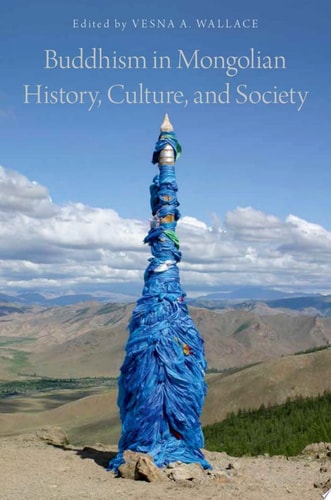
Buddhism in Mongolian History, Culture, and Society
0
0
As an Amazon Associate and affiliate partner, Menrva Books earns from qualifying purchases. Learn more
Author Description
Buddhism in Mongolian History, Culture, and Society explores the unique elements of Mongolian Buddhism while challenging its stereotyped image as a mere replica of Tibetan Buddhism. Vesna A. Wallace brings together an interdisciplinary group of leading scholars to explore the interaction between the Mongolian indigenous culture and Buddhism, the features that Buddhism acquired through its adaptation to the Mongolian cultural sphere, and the ways Mongols have constructed their Buddhist identity. The contributors explore the ways that Buddhism retained unique Mongolian features through Qing and Mongol support, and bring to light the ways in which Mongolian Buddhists saw Buddhism as inseparable from "Mongolness." They show that by being greatly supported by Mongol and Qing empires, suppressed by the communist governments, and experiencing revitalization facilitated by democratization and the challenges posed by modernity, Buddhism underwent a series of transformations while retaining unique Mongolian features.The book covers historical events, social and political conditions, and influential personages in Mongolian Buddhism from the sixteenth century to the present, and addresses the artistic and literary expressions of Mongolian Buddhism and various Mongolian Buddhist practices and beliefs.
Menrva's Summary
THE THESIS
This volume investigates the distinct evolution of Buddhism within the Mongolian cultural sphere, challenging the perception that it is merely a derivative of Tibetan traditions. Editor Vesna A. Wallace, a scholar of Buddhist studies, compiles interdisciplinary research to analyze how Mongolian identity and indigenous practices shaped the religion's development. The text argues that Buddhism became deeply intertwined with the concept of 'Mongolness' through centuries of political support, state suppression, and modern revitalization.
THE SCOPE MAP
What You Will Find
- Historical analysis of Mongolian Buddhism from the sixteenth century to the present.
- Examination of the interplay between Qing imperial policy and Mongolian religious institutions.
- Studies on the impact of communist-era suppression and post-socialist religious revival.
- Discussions on artistic, literary, and ritualistic expressions unique to the region.
Scope Limits
- The text does not provide a comprehensive theological manual for Buddhist practice.
- It does not focus on pre-sixteenth-century religious history or non-Mongolian Buddhist traditions.
THE AUTHORITY PERSPECTIVE
Scholars and historians identify this collection as a significant contribution to Central Asian studies, noting its success in moving beyond monolithic interpretations of Buddhist history. Readers frequently highlight the academic density of the prose and the value of its interdisciplinary approach for understanding the intersection of religion and national identity.
Page Count:
354
Publication Date:
2015-01-01
Publisher:
Oxford University Press
ISBN-10:
0190266937
ISBN-13:
9780190266936
Religion
History
Mongolia history
Special Topics
Sociology
Buddhism
Asian History
Community Tags
Similar Books