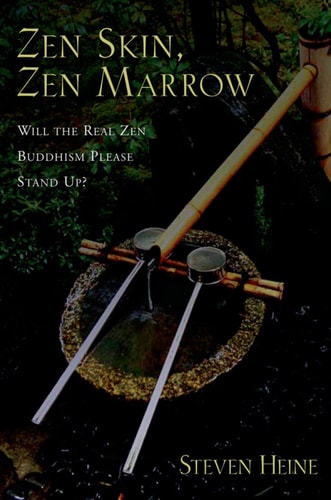
Zen Skin, Zen Marrow: Will the Real Zen Buddhism Please Stand Up?
0
0
As an Amazon Associate and affiliate partner, Menrva Books earns from qualifying purchases. Learn more
Author Description
Since Zen Buddhism first captivated the attention of Western seekers the dominant discourse about this sect has been romantic, idealistic, and utopian. The essence of Zen has been described as ineffable, holistic, and promoting social harmony. In recent years, however, some scholars have begun to examine Zen through the lenses of historical and cultural criticism, producing a sharp challenge to the traditional view. These clashing viewpoints are now entrenched in two warring camps, and their exponents talk past each other with virtually no constructive interaction. In this book, Steven Heine argues that a constructive compromise is possible. He focuses on three principal areas of disagreement: (1) the role of language and discourse in a tradition that claims to be 'outside words and letters,' yet has produced a voluminous body of texts, (2) the function of rituals and objects of worship to gain world benefit in a tradition supposedly founded on unmediated experience attained in an iconoclastic and ascetic environment, (3) the impact of a tradition that espouses peace and harmony on social issues such as class and gender discrimination and on nationalism and imperialism in Japan. Avoiding the stagnant polarization that characterizes most encounters between Zen traditionalists and their critics, he suggests ways in which these two perspectives can complement each other in a more balanced and nuanced alternative position.
Menrva's Summary
THE THESIS
Can the polarized discourse surrounding Zen Buddhism be reconciled through a critical synthesis of traditional idealism and modern historical analysis? Steven Heine, a scholar of East Asian religions, examines the disconnect between the romanticized Western perception of Zen and the findings of contemporary historical criticism. He argues that the current impasse between traditionalists and critics obscures the complexity of the tradition, proposing a framework that integrates textual, ritual, and social dimensions to provide a more nuanced understanding of Zen practice and history.
THE SCOPE MAP
What You Will Find
- Analysis of the paradox between Zen's claim of being 'outside words and letters' and its extensive literary output.
- Examination of the role of rituals and material objects in a tradition often framed as purely iconoclastic.
- Investigation into the historical intersection of Zen with social hierarchies, gender discrimination, and Japanese nationalism.
Scope Limits
- The text does not provide a comprehensive history of Zen Buddhism from its inception to the present day.
- It does not serve as a practical guide for meditation or personal spiritual practice.
THE AUTHORITY PERSPECTIVE
Scholars and students of religious studies frequently cite this work for its ability to bridge the gap between hagiographic accounts and critical historical inquiry. Experts highlight the text as a necessary intervention for those seeking to move beyond simplistic or idealized interpretations of Zen Buddhism.
Page Count:
227
Publication Date:
2007-01-01
Publisher:
Oxford University Press
ISBN-10:
0190296178
ISBN-13:
9780190296179
Religion
Philosophy
History
Zen Buddhism
Asian History
Buddhist
Zen
Buddhism
Community Tags
Similar Books