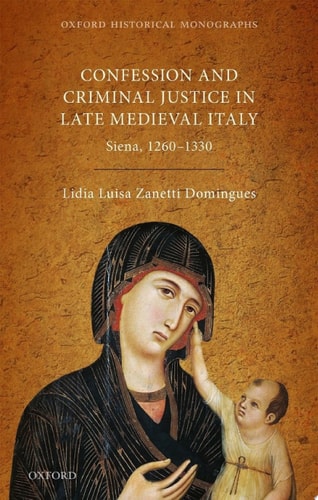
Confession and Criminal Justice in Late Medieval Italy: Siena, 1260-1330
0
0
As an Amazon Associate and affiliate partner, Menrva Books earns from qualifying purchases. Learn more
Author Description
In medieval Italy the practice of revenge as criminal justice was still popular amongst members of all social classes, yet crime also was increasingly perceived as a public matter that needed to be dealt with by the government rather than private citizens. Confession and Criminal Justice in Late Medieval Italy sheds light on this contradiction through an in-depth comparison of lay and religious sources produced in Siena between 1260 and 1330 on criminal justice, conflict, and violence. Confession and Criminal Justice in Late Medieval Italy: argues that religious people were an effective pressure group with regards to criminal justice, thanks both to the literary works they produced and their direct intervention in political affairs, and that their contributions have not received the attention they deserve. It shows that the dichotomy between theories and practices of 'private' and of 'public' justice should be substituted by a framework in which three models, or discourses, of criminal justice are recognised as present in medieval Italian communes, with the addition of a specifically religious discourse based on penitential spirituality. Although the models of criminal justice were competing, they also influenced each other.
Menrva's Summary
THE THESIS
This work investigates how the intersection of penitential spirituality and secular governance shaped the evolution of criminal justice in late medieval Siena. Lidia Luisa Zanetti Domingues, a specialist in medieval Italian history, utilizes a comparative analysis of both lay and religious primary sources to challenge the traditional binary view of private versus public justice. She argues that religious figures acted as a significant political pressure group, introducing a distinct third discourse of justice that influenced the development of communal legal practices between 1260 and 1330.
THE SCOPE MAP
What You Will Find
- Analysis of criminal justice, conflict, and violence in Sienese society.
- A tripartite framework of justice models: private, public, and religious.
- Examination of the influence of penitential literature on political policy.
Scope Limits
- The study is geographically restricted to the city-state of Siena.
- The chronological focus is limited to the period between 1260 and 1330.
THE AUTHORITY PERSPECTIVE
Scholars recognize this monograph as a significant contribution to the study of medieval legal culture and the role of religious institutions in secular governance. Readers frequently note the academic density of the prose and the precision with which the author navigates complex archival sources.
Page Count:
256
Publication Date:
2021-01-01
Publisher:
OUP Oxford
ISBN-10:
0192659332
ISBN-13:
9780192659330
History
European History
Criminology
Legal History
Religion and Law
Italian History
Community Tags
Similar Books