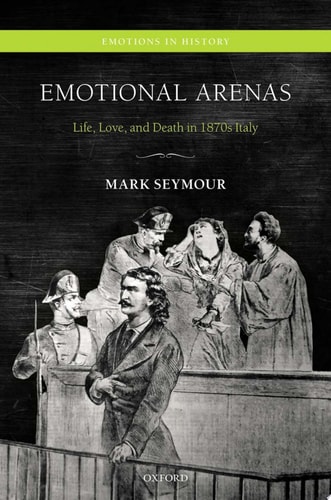
Emotional Arenas: Life, Love, and Death in 1870s Italy
0
0
As an Amazon Associate and affiliate partner, Menrva Books earns from qualifying purchases. Learn more
Author Description
Based on the records of a murder trial that transfixed all of Italy in the late 1870s, this study makes use of a dramatic court case to develop a new paradigm for the history of emotions - the 'emotional arena'. Set in the decade following Italian unification, the context was one of notable cultural variety. An as-yet unexplored aspect of this was that the experience and expression of emotions were as variable as the regions making up the new nation. Through a close examination of the spaces in which daily lives, loves, and deaths unfolded - from marital homes to places of socializing and entertainment, to a Roman court room - Mark Seymour explores the way social 'arenas' are crucial to the historical development of emotional cultural rules. The narrative is driven by the failed marriage of a decorated but allegedly impotent Risorgimento soldier, his wife's scandalous affair with a virile circus artiste (who had a string of previous lovers), and the illicit new couple's murder of the hapless husband. Hundreds of witnesses - from local professionals to servants and even circus clowns - interviewed across the length and breadth of the peninsula, left their personal views on marriage, sexuality, and infidelity. These provide an extraordinary series of peepholes into little-known areas of the new nation's social fabric. A careful yet imaginative reading of the prosecution records, as well as contemporary newspaper coverage, allows reconstruction of the highly emotional experiences of all those touched by this extraordinary story. The result is a classic Italian micro-history with relevance for today's emotionally volatile times.
Menrva's Summary
THE THESIS
This study investigates how the expression of human emotion is shaped by specific social environments, utilizing a high-profile 1870s Italian murder trial as a primary case study. Mark Seymour, a historian specializing in modern Italy, constructs the 'emotional arena' framework to argue that emotional norms were not uniform across the newly unified nation but were instead highly localized and dependent on specific social contexts. By analyzing court records and contemporary media, he demonstrates how regional cultural variety influenced the private lives and public behaviors of citizens during the post-Risorgimento era.
THE SCOPE MAP
What You Will Find
- A detailed micro-historical analysis of an 1870s Italian murder case involving a soldier, his wife, and a circus performer.
- The 'emotional arena' theoretical framework for interpreting historical emotional expression.
- Extensive use of primary source testimony from diverse social strata, including servants, professionals, and performers.
Scope Limits
- The analysis is primarily focused on the specific cultural and regional dynamics of Italy in the 1870s.
- The study does not attempt to provide a comprehensive history of all Italian emotional norms across the entire nineteenth century.
THE AUTHORITY PERSPECTIVE
Historians and scholars of European social history frequently cite this work for its innovative methodology in applying emotional theory to micro-historical case studies. Readers often note the academic density of the prose, which balances rigorous archival research with a compelling narrative structure.
Page Count:
256
Publication Date:
2020-01-01
Publisher:
OUP Oxford
ISBN-10:
0191061263
ISBN-13:
9780191061264
History
Cultural History
European History
Italian History
Social History
Legal History
Italy history
Special Topics
Microhistory
Community Tags
Similar Books