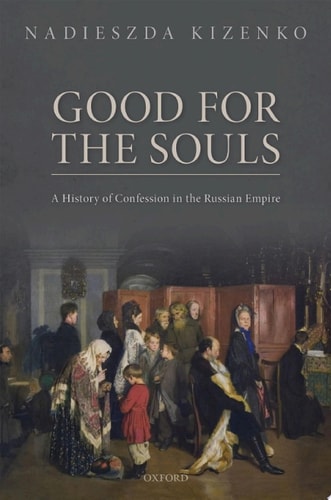
Good for the Souls: A History of Confession in the Russian Empire
0
0
As an Amazon Associate and affiliate partner, Menrva Books earns from qualifying purchases. Learn more
Author Description
From the moment that Tsars as well as hierarchs realized that having their subjects go to confession could make them better citizens as well as better Christians, the sacrament of penance in the Russian empire became a political tool, a devotional exercise, a means of education, and a literary genre. It defined who was Orthodox, and who was 'other.' First encouraging Russian subjects to participate in confession to improve them and to integrate them into a reforming Church and State, authorities then turned to confession to integrate converts of other nationalities. But the sacrament was not only something that state and religious authorities sought to impose on an unwilling populace. Confession could provide an opportunity for carefully crafted complaint. What state and church authorities initially imagined as a way of controlling an unruly population could be used by the same population as a way of telling their own story, or simply getting time off to attend to their inner lives. Good for the Souls brings Russia into the rich scholarly and popular literature on confession, penance, discipline, and gender in the modern world, and in doing so opens a key window onto church, state, and society. It draws on state laws, Synodal decrees, archives, manuscript repositories, clerical guides, sermons, saints' lives, works of literature, and visual depictions of the sacrament in those books and on church iconostases. Russia, Ukraine, and Orthodox Christianity emerge both as part of the European, transatlantic religious continuum-and, in crucial ways, distinct from it.
Menrva's Summary
THE THESIS
This work investigates how the sacrament of confession functioned as a multifaceted instrument of social control, political integration, and personal expression within the Russian Empire. Nadieszda Kizenko, a scholar of Russian religious history, utilizes a vast array of primary sources—including state laws, Synodal decrees, and archival records—to argue that confession was not merely a top-down imposition by church and state authorities. Instead, she demonstrates how the practice evolved into a complex interaction where subjects navigated their identities as citizens and Christians while occasionally utilizing the confessional space for individual agency.
THE SCOPE MAP
What You Will Find
- Analysis of the intersection between state policy and religious practice in the Russian Empire.
- Examination of confession as a tool for defining Orthodox identity and managing non-Orthodox populations.
- Use of diverse primary sources including sermons, clerical guides, literature, and visual iconography.
Scope Limits
- The study focuses primarily on the Russian Empire and does not provide an exhaustive comparative analysis of confession in non-Orthodox Western European contexts.
- The text prioritizes institutional and social history over purely theological or dogmatic developments.
THE AUTHORITY PERSPECTIVE
Scholars recognize this text as a significant contribution to the study of Russian religious life, noting its ability to bridge the gap between institutional history and the lived experience of the populace. Readers frequently highlight the depth of the archival research and the clarity with which the author navigates the complex relationship between the Russian Church and the Imperial State.
Page Count:
343
Publication Date:
2021-01-01
Publisher:
OUP Oxford
ISBN-10:
0192650572
ISBN-13:
9780192650573
History
Orthodox Christianity
Sociology of Religion
Religious History
Russian History
European History