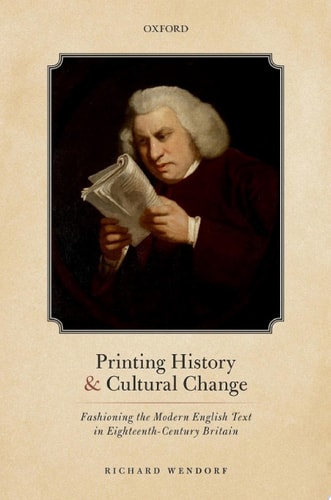
Printing History and Cultural Change: Fashioning the Modern English Text in Eighteenth-Century Britain
0
0
As an Amazon Associate and affiliate partner, Menrva Books earns from qualifying purchases. Learn more
Author Description
This study provides one of the most detailed and comprehensive examinations ever devoted to a critical transformation in the material substance of the printed page; it carries out this exploration in the history of the book, moreover, by embedding these typographical changes in the context of other cultural phenomena in eighteenth-century Britain. The gradual abandonment of pervasive capitalization, italics, and caps and small caps in books printed in London, Dublin, and the American colonies between 1740 and 1780 is mapped in five-year increments which reveal that the appearance of the modern page in English began to emerge around 1765. This descriptive and analytical account focuses on poetry, classical texts, Shakespeare, contemporary plays, the novel, the Bible, the Book of Common Prayer, sermons and religious writings, newspapers, magazines, anthologies, government publications, and private correspondence; it also examines the reading public, canon formation, editorial theory and practice, and the role of typography in textual interpretation. These changes in printing conventions are then compared to other aspects of cultural change: the adoption of the Gregorian calendar in 1752, the publication of Johnson's Dictionary in 1755, the transformation of shop signs and the imposition of house numbers in London beginning in 1762, and the evolution of the English language and of English prose style. This study concludes that this fundamental shift in printing conventions was closely tied to a pervasive interest in refinement, regularity, and standardization in the second half of the century--and that it was therefore an important component in the self-conscious process of modernizing British culture.
Menrva's Summary
THE THESIS
How did the material transformation of the printed page in eighteenth-century Britain reflect and contribute to the broader modernization of English culture? Richard Wendorf, a scholar of eighteenth-century literature and culture, investigates the systematic abandonment of pervasive capitalization and italics in printed texts between 1740 and 1780. By analyzing these typographical shifts alongside contemporary cultural developments, Wendorf argues that the move toward a cleaner, more standardized page was a deliberate effort to align printing conventions with the era's growing emphasis on refinement and regularity.
THE SCOPE MAP
What You Will Find
- A longitudinal study of printing conventions in London, Dublin, and the American colonies from 1740 to 1780.
- Comparative analysis between typography and cultural markers like the Gregorian calendar, Johnson's Dictionary, and urban planning.
- Examination of diverse text types including poetry, classical literature, religious texts, and newspapers.
Scope Limits
- The study focuses primarily on the British and colonial English-speaking world, excluding broader European continental printing trends.
- It does not provide an exhaustive history of printing technology itself, but rather focuses on the aesthetic and cultural implications of typographical choices.
THE AUTHORITY PERSPECTIVE
Scholars and historians of the book recognize this work as a foundational text for understanding the transition from early modern to modern printing aesthetics. Readers frequently note the meticulous nature of the data collection, which provides a rigorous framework for analyzing how material culture shapes textual interpretation.
Page Count:
348
Publication Date:
2022-01-01
Publisher:
OUP Oxford
ISBN-10:
0192653121
ISBN-13:
9780192653123
History
Eighteenth Century
Typography
Literary Criticism
Cultural History
Printing History
Indigenous