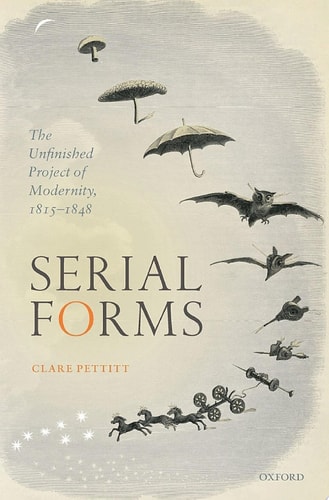
Serial Forms: The Unfinished Project of Modernity, 1815-1848
0
0
As an Amazon Associate and affiliate partner, Menrva Books earns from qualifying purchases. Learn more
Author Description
Serial Forms: The Unfinished Project of Modernity, 1815-1848 proposes an entirely new way of reading the transition into the modern. It is the first book in a series of three which will take the reader up to the end of the First World War, moving from a focus on London to a global perspective. Serial Forms sets out the theoretical and historical basis for all three volumes. It suggests that, as a serial news culture and a stadial historicism developed together between 1815 and 1848, seriality became the dominant form of the nineteenth century. Through serial newsprint, illustrations, performances, and shows, the past and the contemporary moment enter into public visibility together. Serial Forms argues that it is through seriality that the social is represented as increasingly politically urgent. The insistent rhythm of the serial reorganizes time, recalibrates and rescales the social, and will prepare the way for the 1848 revolutions which are the subject of the next book. By placing their work back into the messy print and performance culture from which it originally appeared, Serial Forms is able to produce new and exciting readings of familiar authors such as Scott, Byron, Dickens, and Gaskell. Rather than offering a rarefied intellectual history or chopping up the period into 'Romantic' and 'Victorian', Clare Pettitt tracks the development of communications technologies and their impact on the ways in which time, history and virtuality are imagined.
Menrva's Summary
THE THESIS
This book investigates how the emergence of seriality in news culture and historicism between 1815 and 1848 fundamentally reshaped the modern experience of time and social visibility. Clare Pettitt, a scholar of nineteenth-century literature and culture, utilizes a framework that bridges print media, performance, and historical theory. She argues that the rhythmic, repetitive nature of serial forms provided the structural foundation for the political urgency that culminated in the 1848 revolutions. By analyzing the intersection of communication technologies and social representation, the author challenges traditional periodization of the nineteenth century.
THE SCOPE MAP
What You Will Find
- Analysis of serial newsprint, illustrations, and public performances.
- A theoretical framework linking stadial historicism to serial media.
- Re-evaluations of canonical authors including Scott, Byron, Dickens, and Gaskell.
Scope Limits
- The study is restricted to the period between 1815 and 1848.
- The geographic focus is primarily centered on London rather than a global perspective.
THE AUTHORITY PERSPECTIVE
Scholars recognize this work as a significant intervention in nineteenth-century studies, particularly for its refusal to adhere to the standard divide between Romantic and Victorian eras. Readers frequently note the density of the theoretical prose, which serves as a foundational text for the author's broader project on modernity.
Page Count:
366
Publication Date:
2020-01-01
Publisher:
OUP Oxford
ISBN-10:
0192566172
ISBN-13:
9780192566171
History
Indigenous
Nineteenth century
Serial publications
19th Century
Literary Criticism
Cultural History
Media Studies
Community Tags
Similar Books