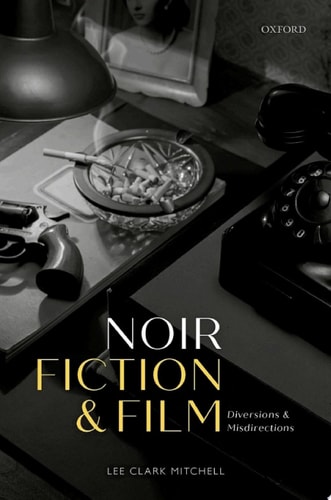
Noir Fiction and Film: Diversions and Misdirections
0
0
As an Amazon Associate and affiliate partner, Menrva Books earns from qualifying purchases. Learn more
Author Description
The argument of Noir Fiction and Film is curiously counterintuitive: that in a century of hard-boiled fiction and detective films, characteristics that at first seemed trivial swelled in importance, flourishing into crucial aspects of the genre. Among these are aimless descriptions of people and places irrelevant to plot, along with detectives consisting of little more than sparkling dialogue and flippant attitudes. What weaves together such features, however, seems to be a paradox: that a genre rooted in solving a mystery, structured around the gathering of clues, must do so by misdirecting our attention, even withholding information we think we need to generate the suspense we also desire. Yet successful noir stories and films enhance that suspense through passing diversions (descriptive details and eccentric perspectives) rather than depending on the center pieces of plot alone (suspected motives or incriminating traces). As the greatest practitioners of the genre have realized, the "how" of detective fiction (its stylistic detours) draws us in more insistently than the "what" or the "who" (its linear advance). And the achievement of recent film noir is to make that "how" become the tantalizing object of our entire attention, shorn of any pretense of reading for the plot, immersing us in the diversionary delight that has animated the genre from the beginning.
Menrva's Summary
THE THESIS
This book investigates the counterintuitive argument that the defining characteristics of noir fiction and film are not found in plot resolution, but in the stylistic diversions and misdirections that delay it. Mitchell, a scholar of American literature and film, posits that the genre's enduring appeal relies on the tension between the necessity of solving a mystery and the deliberate withholding of information. By analyzing the evolution of hard-boiled narratives, the author demonstrates how descriptive irrelevancies and flippant characterizations serve as the primary mechanisms for generating suspense.
THE SCOPE MAP
What You Will Find
- Analysis of hard-boiled detective fiction and classic film noir
- Examination of narrative techniques involving misdirection and information withholding
- Study of the relationship between stylistic detours and audience engagement
- Evaluation of how modern noir prioritizes stylistic 'how' over linear 'what'
Scope Limits
- Does not provide a comprehensive history of every noir film ever produced
- Does not focus on the sociological or political origins of the genre
THE AUTHORITY PERSPECTIVE
Scholars and critics recognize this work as a sophisticated contribution to genre theory that challenges traditional structuralist readings of detective narratives. Readers frequently note the academic density of the prose, which is best suited for those already familiar with film and literary criticism.
Page Count:
253
Publication Date:
2021-01-01
Publisher:
OUP Oxford
ISBN-10:
0192659154
ISBN-13:
9780192659156
History
Noir
Detective
Film Noir
Indigenous
Criticism history
Fiction noir
Fiction
Literary Criticism
Film Studies
Community Tags
Similar Books