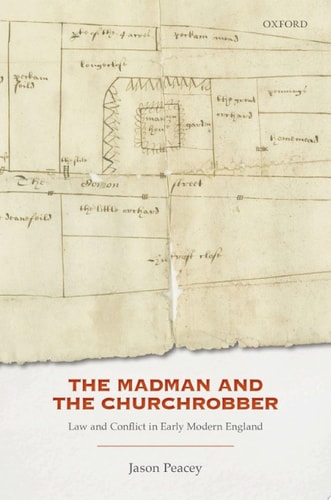
The Madman and the Churchrobber: Law and Conflict in Early Modern England
0
0
As an Amazon Associate and affiliate partner, Menrva Books earns from qualifying purchases. Learn more
Author Description
This microhistory reconstructs and analyses a protracted legal dispute over a small parcel of land called Warrens Court in Nibley, Gloucestershire, which was contested between successive generations of two families from the mid-sixteenth century to the early eighteenth century. Employing a rich cache of archival material, Jason Peacey traces legal contestation over time and through a range of different courts, as well as in Parliament and the public domain, and contends that a microhistorical approach makes it possible to shed valuable light upon the legal and political culture of early modern England, not least by comprehending how certain disputes became protracted and increasingly bitter, and why they fascinated contemporaries. This involves recognising the dynamic of litigation, in terms of how disputes changed over time, and how those involved in myriad lawsuits found legal reasons for prolonging contestation. It also involves exploring litigants' strategies and practices, as well as competing claims about the way in which adversaries behaved, and incompatible expectations of the legal system. Finally, it involves teasing out the structural issues in play, in terms of the social, cultural, and ideological identities of successive generations. Ultimately, this dispute is employed to address important historiographical debates surrounding the nature of civil litigation in early modern England, and to provide new ways of appreciating the nature, severity, and visibility of political and religious conflict in the decades before and after the English Revolution.
Menrva's Summary
THE THESIS
This work investigates the mechanisms and cultural significance of long-term civil litigation in early modern England through the lens of a multi-generational land dispute. Jason Peacey, a historian specializing in the political and social history of the seventeenth century, utilizes a specific case study of the Warrens Court property in Gloucestershire to examine how legal conflicts evolved over nearly two centuries. By analyzing archival records, he argues that these protracted disputes were not merely local anomalies but reflections of broader structural, political, and religious tensions that defined the era.
THE SCOPE MAP
What You Will Find
- A detailed microhistorical analysis of the Warrens Court land dispute from the mid-sixteenth to the early eighteenth century.
- An examination of litigation strategies, legal maneuvering, and the use of various court systems and parliamentary channels.
- An exploration of how social, cultural, and ideological identities influenced the persistence of legal conflict.
Scope Limits
- The study is geographically confined to the specific case of Nibley, Gloucestershire, and does not provide a comprehensive survey of all English legal practices.
- It focuses primarily on civil litigation rather than criminal law or broader constitutional theory.
THE AUTHORITY PERSPECTIVE
Historians recognize this text as a significant contribution to the study of early modern legal culture, noting its ability to connect granular archival detail to larger historiographical debates. Scholars frequently highlight the author's methodological rigor in demonstrating how local disputes served as proxies for national political and religious anxieties.
Page Count:
329
Publication Date:
2022-01-01
Publisher:
OUP Oxford
ISBN-10:
0192651684
ISBN-13:
9780192651686
History
Law history
Early Modern
History of the Americas
Law
Legal History
Land tenure
Microhistory
Social History
Political History
Great Britain
Community Tags
Similar Books