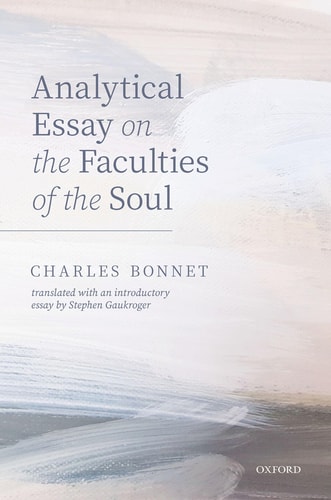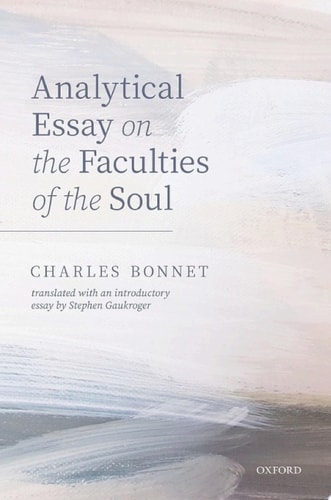
Analytical Essay on the Faculties of the Soul
0
0
As an Amazon Associate and affiliate partner, Menrva Books earns from qualifying purchases. Learn more
Author Description
In the course of the eighteenth century, understanding human cognitive life came to be construed as something to be explored in terms of the physiology of the sensory organs, the nerves, and the brain: a form of naturalization that effectively moved cognition out of the realm of philosophy as it had traditionally been understood. Bonnet's Analytical Essay on the Faculties of the Soul was at the forefront of these developments, and this is its first English translation. Drawing on his earlier work in natural history--he was the leading entomologist of his era--he approaches problems of the nature of the mind via the physiology and anatomy of the brain and sensory systems. His approach is one of 'reverse engineering', starting from an organic statue without faculties, and investigating how it would need to be modified to produce a human being. Bonnet takes up a position that cuts across the standard understanding of the period as a clash between materialism and dualism. While his approach was rigorously naturalistic and physiological, this did not lead him to reject the notion of a soul. Instead, he argues that, in order to make sense of their sensory abilities, we need to attribute a soul to animals as well as human beings. At the same time, he argues that if personal immortality is to be possible, it can be conceived along the lines of insect metamorphosis, which shows how different biological forms can harbour a single identity.
Menrva's Summary
THE THESIS
This work investigates how the eighteenth-century naturalization of cognition, through the study of sensory physiology and anatomy, challenged traditional philosophical boundaries regarding the nature of the soul. Patrick Hayes provides a critical translation and analysis of Charles Bonnet’s seminal text, situating his work within the broader context of Enlightenment-era natural history. The author examines Bonnet’s unique 'reverse engineering' methodology, which utilizes biological models—specifically insect metamorphosis—to reconcile physiological materialism with the existence of the soul and the possibility of personal immortality.
THE SCOPE MAP
What You Will Find
- An analysis of eighteenth-century sensory physiology and its impact on cognitive theory.
- A detailed examination of Bonnet’s 'statue' thought experiment as a tool for understanding human faculties.
- A synthesis of biological observation and metaphysical inquiry regarding the soul.
Scope Limits
- The text does not provide a comprehensive history of all Enlightenment-era philosophers, focusing primarily on Bonnet’s specific contributions.
- It does not offer a modern neuroscientific validation of Bonnet’s theories, remaining strictly within the historical and philosophical context of the period.
THE AUTHORITY PERSPECTIVE
Scholars and historians of philosophy recognize this translation as a vital resource for understanding the transition from classical metaphysics to modern cognitive science. Readers frequently note the academic density of the prose, which requires a foundational understanding of Enlightenment-era intellectual history to fully appreciate the nuances of Bonnet’s arguments.
Page Count:
268
Publication Date:
2022-01-01
Publisher:
OUP Oxford
ISBN-10:
0192662198
ISBN-13:
9780192662194
Philosophy
Science History
Neuroscience
History & Surveys
18th century
Community Tags
Similar Books