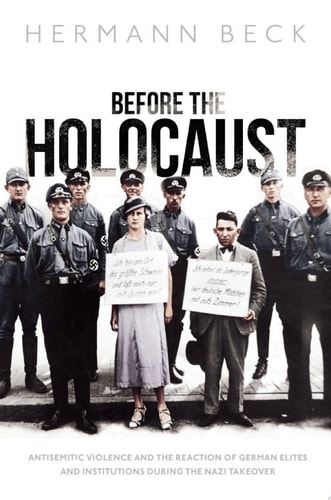
Before the Holocaust: Antisemitic Violence and the Reaction of German Elites and Institutions during the Nazi Takeover
0
0
As an Amazon Associate and affiliate partner, Menrva Books earns from qualifying purchases. Learn more
Author Description
As the Nazis staged their takeover in 1933, instances of antisemitic violence began to soar. While previous historical research assumed that this violence happened much later, Hermann Beck counteracts this, drawing on sources from twenty German archives, and focussing on this early violence, and on the reaction of German institutions and the elites who led them. Before the Holocaust examines the antisemitic violence experienced in this period - from boycotts, violent attacks, robbery, extortion, abductions, and humiliating 'pillory marches', to grievous bodily harm and murder - which has hitherto not been adequately recognized. Beck then analyses the reactions of those institutions that still had the capacity to protest against Nazi attacks and legislative measures - the Protestant Church, the Catholic Church, the bureaucracies, and Hitler's conservative coalition partner, the DNVP - and the mindset of the elites who led them, to determine their various responses to flagrant antisemitic abuses. Individual protests against violent attacks, the April boycott, and Nazi legislative measures were already hazardous in March and April 1933, but established institutions in the German State and society were still able to voice their concerns and raise objections. By doing so, they might have stopped or at least postponed a radicalization that eventually led to the pogrom of 1938 (Kristallnacht) and the Holocaust.
Menrva's Summary
THE THESIS
This work investigates the extent of early antisemitic violence during the 1933 Nazi takeover and evaluates the failure of German elites and institutions to effectively challenge these initial radical actions. Hermann Beck, a historian specializing in modern German history, utilizes extensive primary source material from twenty German archives to reconstruct the climate of 1933. He argues that while institutions like the churches and conservative political partners possessed the capacity to protest, their inconsistent and often muted responses allowed for the rapid normalization of state-sponsored violence that preceded the later Holocaust.
THE SCOPE MAP
What You Will Find
- Detailed documentation of antisemitic acts including boycotts, public humiliation, and physical violence occurring in early 1933.
- Analysis of the decision-making processes within the Protestant and Catholic churches, the civil bureaucracy, and the DNVP.
- Examination of the political environment immediately following Hitler's appointment as Chancellor.
Scope Limits
- The study focuses primarily on the period surrounding the 1933 transition and does not provide a comprehensive history of the entire Nazi era.
- The analysis is restricted to the reactions of established German institutions rather than the broader public response.
THE AUTHORITY PERSPECTIVE
Historians recognize this text as a significant contribution to the study of the Nazi rise to power, specifically for its focus on the overlooked violence of 1933. Scholars frequently highlight the depth of archival research as a primary strength that challenges previous assumptions about the timeline of Nazi radicalization.
Page Count:
569
Publication Date:
2022-01-01
Publisher:
OUP Oxford
ISBN-10:
0192688510
ISBN-13:
9780192688514
History
European History
Nazi Germany
Antisemitism
Jewish History
Community Tags
Similar Books