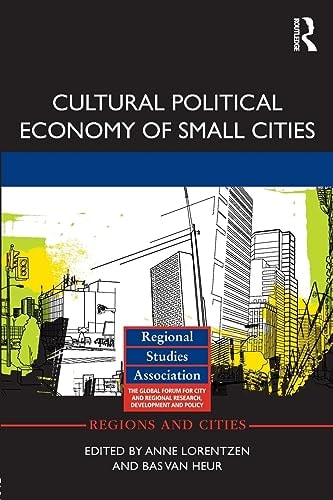
Cultural Political Economy of Small Cities
0
0
As an Amazon Associate and affiliate partner, Menrva Books earns from qualifying purchases. Learn more
Author Description
The volume highlights ongoing changes in the political economy of small cities in relation to the field of culture and leisure. Culture and leisure are focal points both to local entrepreneurship and to planning by city governments, which means that these developments are subject to market dynamics as well as to political discourse and action. Public-private partnerships as well as conflicts of interests characterise the field, and a major issue related to the strategic development of culture and leisure is the balance between market and welfare. This field is gaining importance in most cities today in planning, production and consumption, but to the extent that these changes have drawn academic attention it has focused on large, metropolitan areas and on creative clusters and flagship high culture projects. Smaller cities and their often substantively different cultural strategies have been largely ignored, thus leading to a huge gap in our knowledge on contemporary urban change. By bringing together a number of case studies as well as theoretical reflections on the cultural political economy of small cities, this volume contributes to an emerging small cities research agenda and to the development of policy-relevant expertise that is sensitive to place-specific cultural dynamics. In taking this approach, the volume hopes to contribute to emerging research on culture and leisure economies by developing a differentiated spatial dimension to it, without which sustainable urban strategies cannot be developed. This book integrates perspectives of economic development with questions of governance and equity in relation to the fields of culture and leisure planning and development. This book should be of interest to students and researchers of Urban Studies and Planning, Regional Studies and Economics, as well as Sociology and Geography.
Menrva's Summary
THE THESIS
This volume investigates the evolving political economy of small cities, focusing on the intersection of culture and leisure. The book examines how culture and leisure are central to local entrepreneurship and municipal planning, influenced by market forces, political discourse, and public-private partnerships. It addresses the critical balance between market-driven development and public welfare in these sectors, a balance often overlooked in research that primarily focuses on large metropolitan areas. By presenting case studies and theoretical reflections, the work aims to fill a knowledge gap regarding the unique cultural strategies of smaller cities and inform policy-relevant expertise sensitive to place-specific dynamics.
THE SCOPE MAP
- Analysis of cultural and leisure developments in small cities.
- Exploration of the interplay between market dynamics and political discourse.
- Examination of public-private partnerships and conflicts of interest.
- Discussion on the balance between market and welfare in cultural planning.
- Case studies of small cities' cultural strategies.
- Theoretical reflections on the cultural political economy of small cities.
- Contribution to an emerging small cities research agenda.
- Integration of economic development, governance, and equity perspectives.
THE AUTHORITY PERSPECTIVE
This volume is positioned as a significant contribution to urban studies and planning, particularly for researchers and students in regional studies, economics, sociology, and geography. It addresses a notable gap in academic literature by focusing on the cultural political economy of smaller cities, which have historically been under-researched compared to metropolitan areas. The book's approach integrates economic development with governance and equity, aiming to provide policy-relevant expertise sensitive to local cultural dynamics. Its case studies and theoretical reflections are intended to foster a more differentiated spatial understanding of culture and leisure economies, crucial for developing sustainable urban strategies.
Page Count:
218
Publication Date:
2013-04-17
Publisher:
Routledge
ISBN-10:
041581863X
ISBN-13:
9780415818636
Politics
Non-Fiction
Economics
Public Policy
Small cities
Governance
Urban Studies
Community Tags
Other Editions(6)



Similar Books



Reader Comments
Share Your Thoughts
No comments yet. Be the first to share your thoughts!