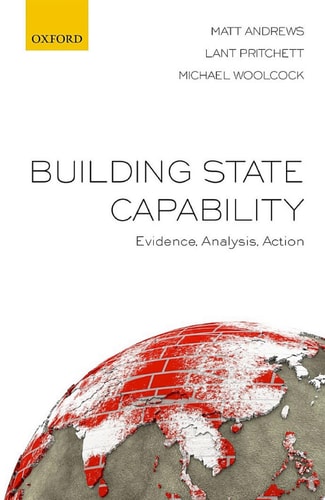
Building State Capability: Evidence, Analysis, Action
0
0
As an Amazon Associate and affiliate partner, Menrva Books earns from qualifying purchases. Learn more
Author Description
This is an open access title available under the terms of a CC BY-NC-ND 4.0 licence. It is free to read at Oxford Scholarship Online and offered as a free PDF download from OUP and selected open access locations. Governments play a major role in the development process, and constantly introduce reforms and policies to achieve developmental objectives. Many of these interventions have limited impact, however; schools get built but children don't learn, IT systems are introduced but not used, plans are written but not implemented. These achievement deficiencies reveal gaps in capabilities, and weaknesses in the process of building state capability. This book addresses these weaknesses and gaps. It starts by providing evidence of the capability shortfalls that currently exist in many countries, showing that many governments lack basic capacities even after decades of reforms and capacity building efforts. The book then analyses this evidence, identifying capability traps that hold many governments back - particularly related to isomorphic mimicry (where governments copy best practice solutions from other countries that make them look more capable even if they are not more capable) and premature load bearing (where governments adopt new mechanisms that they cannot actually make work, given weak extant capacities). The book then describes a process that governments can use to escape these capability traps. Called PDIA (problem driven iterative adaptation), this process empowers people working in governments to find and fit solutions to the problems they face. The discussion about this process is structured in a practical manner so that readers can actually apply tools and ideas to the capability challenges they face in their own contexts. These applications will help readers devise policies and reforms that have more impact than those of the past.
Menrva's Summary
THE THESIS
This book investigates why government reforms in developing nations frequently fail to achieve developmental objectives despite decades of intervention. The authors, Lant Pritchett, Matt Andrews, and Michael Woolcock, utilize extensive evidence from international development projects to argue that governments often fall into 'capability traps.' They propose a framework called Problem Driven Iterative Adaptation (PDIA) to help practitioners move beyond superficial reforms and build genuine state capacity.
THE SCOPE MAP
What You Will Find
- Analysis of isomorphic mimicry and premature load bearing in public sector reform.
- The PDIA (Problem Driven Iterative Adaptation) methodology for policy implementation.
- Case studies illustrating the failure of 'best practice' adoption in weak institutional environments.
Scope Limits
- The text focuses primarily on institutional reform and state capability rather than macroeconomic policy or political theory.
- It does not provide a universal blueprint for all governance challenges, emphasizing context-specific solutions instead.
THE AUTHORITY PERSPECTIVE
Experts in international development and public administration frequently cite this work as a foundational text for understanding the limitations of traditional reform models. Readers often note the academic rigor of the analysis while appreciating the practical, actionable nature of the PDIA framework for field practitioners.
Page Count:
275
Publication Date:
2017-01-01
Publisher:
OUP Oxford
ISBN-10:
0191064696
ISBN-13:
9780191064692
Governance
Public Policy
International Development
Community Tags
Similar Books