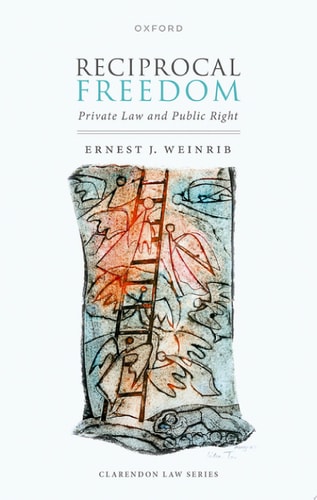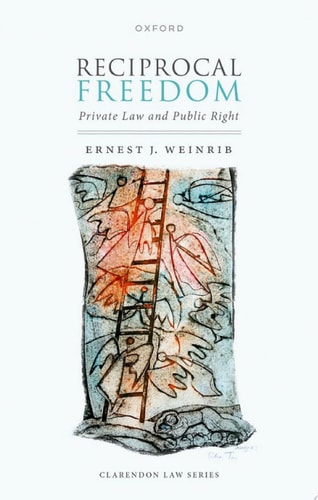
Reciprocal Freedom: Private Law and Public Right
0
0
As an Amazon Associate and affiliate partner, Menrva Books earns from qualifying purchases. Learn more
Author Description
Reciprocal Freedom elucidates the relationship between private law and the state, presenting reciprocal freedom as the normative idea underlying a legal order in which private law occupies a distinctive place. Weinrib develops a set of interconnected conceptions of private law, corrective justice, rights, ownership, the role of legal institutions, distributive justice, the relationship of constitutional rights to private law, and the rule of law. The book is explicitly Kantian in inspiration; it presents a non-instrumental account of law that is geared to the juridical character of the modern liberal state. Combining legal and philosophical analysis, it offers a sequenced and legally informed argument for understanding law as necessary to our co-existence as free beings.
Menrva's Summary
THE THESIS
This work investigates the normative foundations of private law and its essential role in maintaining a legal order based on reciprocal freedom. Ernest J. Weinrib, a prominent legal scholar, utilizes a Kantian framework to argue that private law is not merely an instrument of public policy but a necessary condition for the co-existence of free individuals. He synthesizes concepts of corrective justice, rights, and the rule of law to provide a coherent account of the modern liberal state's juridical character.
THE SCOPE MAP
What You Will Find
- A systematic analysis of the relationship between private law and public right
- A detailed exploration of corrective versus distributive justice
- A philosophical examination of ownership and legal institutions
- An integration of Kantian political theory with contemporary legal doctrine
Scope Limits
- The text does not provide a comprehensive history of specific common law statutes or case law precedents
- It does not address empirical sociological impacts of private law in non-liberal political systems
THE AUTHORITY PERSPECTIVE
Legal scholars and philosophers frequently cite this text as a rigorous, high-level contribution to the field of private law theory. Readers often note the significant intellectual density of the prose, which requires a strong background in jurisprudence to fully appreciate the author's arguments.
Page Count:
230
Publication Date:
2022-01-01
Publisher:
OUP Oxford
ISBN-10:
019269393X
ISBN-13:
9780192693938
Law
Professional Career & Trade
Jurisprudence
Political Philosophy
Kantian Ethics