Minority Governments in Comparative Perspective
0
0
As an Amazon Associate and affiliate partner, Menrva Books earns from qualifying purchases. Learn more
Author Description
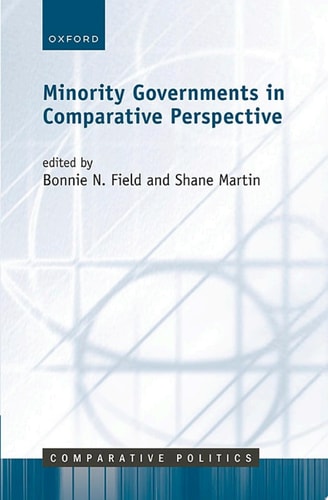
Approximately one-third of parliamentary democracies are or are typically ruled by a minority government - a situation where the party or parties represented at cabinet do not between them hold a majority of seats in the national legislature. Minority governments are particularly interesting in parliamentary systems, where the government is politically responsible to parliament, can be removed by it, and needs (majority) support in the parliament to legislate.The chapters in this volume explore and analyse the formation, functioning, and performance of minority governments, what we term the why, how, and how well. The volume begins with overviews of the concept of and puzzles surrounding minority governments in parliamentary systems, and establishes the current terms of the debate. In the thirteen chapters that follow, leading country experts present in-depth case studies that provide rich, contextualized analyses of minority governments in different settings. The final chapter draws broader, comparative-based conclusions from the country studies that push the literature forward and outline directions for future research on minority governments.Comparative Politics is a series for researchers, teachers, and students of political science that deals with contemporary government and politics. Global in scope, books in the series are characterized by a stress on comparative analysis and strong methodological rigour. The series is published in association with the European Consortium for Political Research. For more information visit: www.ecprnet.eu.The series is edited by Nicole Bolleyer, Chair of Comparative Political Science, Geschwister Scholl Institut, LMU Munich and Jonathan Slapin, Professor of Political Institutions and European Politics, Department of Political Science, University of Zurich.
Menrva's Summary
THE THESIS
This volume investigates the formation, operational mechanics, and legislative performance of minority governments within parliamentary democracies. Editors Shane Martin and Bonnie N. Field compile research from leading political scientists to address the paradox of how cabinets lacking a legislative majority maintain political stability and pass policy in systems where they are theoretically vulnerable to removal.
THE SCOPE MAP
What You Will Find
- Theoretical frameworks defining the 'why, how, and how well' of minority governance.
- Thirteen country-specific case studies providing empirical data on diverse parliamentary settings.
- Comparative analysis synthesizing findings to identify broader patterns in legislative behavior.
Scope Limits
- The text focuses exclusively on parliamentary systems and does not address presidential or semi-presidential minority executive structures.
- It does not provide a prescriptive guide for political parties but rather an analytical observation of existing systems.
THE AUTHORITY PERSPECTIVE
Experts identify this volume as a rigorous academic resource for students and researchers of institutional design and legislative politics. Readers frequently note the high level of methodological detail and the value of the comparative approach in understanding modern democratic governance.
Page Count:
563
Publication Date:
2022-01-01
Publisher:
OUP Oxford
ISBN-10:
0192699547
ISBN-13:
9780192699541
Government
Parliamentary Systems
Public Policy
Comparative Politics
Community Tags
Similar Books