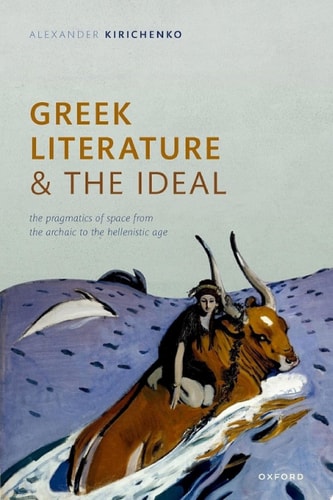
Greek Literature and the Ideal: The Pragmatics of Space from the Archaic to the Hellenistic Age
0
0
As an Amazon Associate and affiliate partner, Menrva Books earns from qualifying purchases. Learn more
Author Description
Greek Literature and the Ideal contends that the development of Greek literature was motivated by the need to endow political geography with a sense of purposeful structure. Alexander Kirichenko argues that Greek literature was a crucial factor in the cultural production of space, and Greek geography a crucial factor in the production of literary meaning. The book focuses on the idealizing images that Greek literature created of three spatial patterns of power distribution: a decentralized network of aristocratically governed communities (Archaic Greece); a democratic city controlling an empire (Classical Athens); and a microcosm of Greek culture located on foreign soil, ruled by quasi-divine royals, and populated by immigrants (Ptolemaic Alexandria). Kirichenko draws connections between the formation of these idealizing images and the emergence of such literary modes of meaning making as the authoritative communication of the truth, the dialogic encouragement to search for the truth on one's own, and the abandonment of transcendental goals for the sake of cultural memory and/or aesthetic pleasure. Readings of such canonical Greek authors as Homer, Hesiod, the tragedians, Thucydides, Plato, Callimachus, and Theocritus show that the pragmatics of Greek literature (the sum total of the ideological, cognitive, and emotional effects that it seeks to produce) is, in essence, always a pragmatics of space: there is a strong correlation between the historically conditioned patterns of political geography and the changing mechanisms whereby Greek literature enabled its recipients to make sense of their world.
Menrva's Summary
THE THESIS
This work investigates how the evolution of Greek literature served as a mechanism for structuring political geography and defining spatial power dynamics from the Archaic to the Hellenistic periods. Alexander Kirichenko, a scholar of classical literature, posits that literary production and geographical conceptualization were mutually constitutive. By analyzing canonical texts, he argues that the pragmatics of Greek literature—its intended ideological and cognitive effects—are fundamentally rooted in the spatial organization of the societies that produced them.
THE SCOPE MAP
What You Will Find
- Analysis of spatial patterns in Archaic, Classical, and Hellenistic political structures
- Examination of literary modes including authoritative truth-telling and dialogic inquiry
- Close readings of Homer, Hesiod, Thucydides, Plato, Callimachus, and Theocritus
- Theoretical framework linking political geography to cognitive meaning-making
Scope Limits
- Does not provide a comprehensive history of all Greek literary genres
- Focuses primarily on the intersection of space and power rather than purely aesthetic or linguistic analysis
THE AUTHORITY PERSPECTIVE
Scholars recognize this text as a sophisticated contribution to the study of classical literature and political theory. Readers frequently note the academic density of the prose, which is intended for an audience familiar with classical philology and historical geography.
Page Count:
300
Publication Date:
2022-01-01
Publisher:
OUP Oxford
ISBN-10:
0192692003
ISBN-13:
9780192692009
History
English
Literary Criticism
English & College Success
Political Geography
Ancient Greece