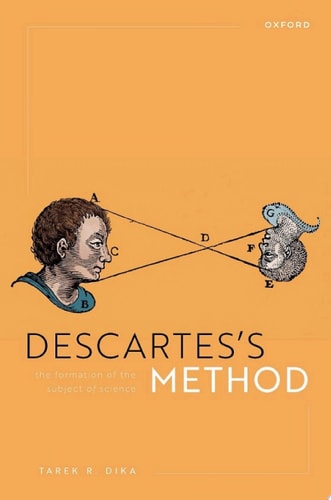
Descartes's Method: The Formation of the Subject of Science
0
0
As an Amazon Associate and affiliate partner, Menrva Books earns from qualifying purchases. Learn more
Author Description
Descartes's Method develops an ontological interpretation of Descartes's method as a dynamic and, within limits, differentiable problem-solving cognitive disposition or habitus, which can be actualized or applied to different problems in various ways, depending on the nature of the problem. Parts I-II develop the foundations of an habitual interpretation of Descartes's method, while Parts III-V demonstrate the fruits of such an interpretation in metaphysics, natural philosophy, and mathematics. The first book to draw on the recently discovered Cambridge manuscript of Descartes's Rules for the Direction of the Mind, Descartes's Method concretely demonstrates the efficacy of Descartes's method in the sciences and the underlying unity of Descartes's method from Rules for the Direction of the Mind to Principles of Philosophy (1644).
Menrva's Summary
THE THESIS
This work investigates whether Descartes's method functions as a dynamic, differentiable cognitive habitus rather than a static set of logical rules. Tarek R. Dika, a scholar of early modern philosophy, utilizes the recently discovered Cambridge manuscript of the Rules for the Direction of the Mind to re-evaluate the Cartesian framework. By bridging the gap between the Rules and the Principles of Philosophy, Dika argues for an underlying ontological unity in Descartes's approach to problem-solving across diverse scientific domains.
THE SCOPE MAP
What You Will Find
- An ontological interpretation of Cartesian methodology as a cognitive habitus.
- Analysis of the Cambridge manuscript of the Rules for the Direction of the Mind.
- Applications of the method within metaphysics, natural philosophy, and mathematics.
Scope Limits
- The text focuses specifically on the development and application of the method rather than a comprehensive biography of Descartes.
- It does not provide an exhaustive critique of post-Cartesian interpretations of his logic.
THE AUTHORITY PERSPECTIVE
Scholars recognize this text as a significant contribution to Cartesian studies due to its integration of previously unavailable manuscript evidence. Experts highlight the book's rigorous academic density and its success in reorienting the debate surrounding the unity of Descartes's philosophical project.
Page Count:
406
Publication Date:
2023-01-01
Publisher:
OUP Oxford
ISBN-10:
0192696947
ISBN-13:
9780192696946
Philosophy
Metaphysics
Science History
Mathematics
Epistemology
Community Tags
Similar Books