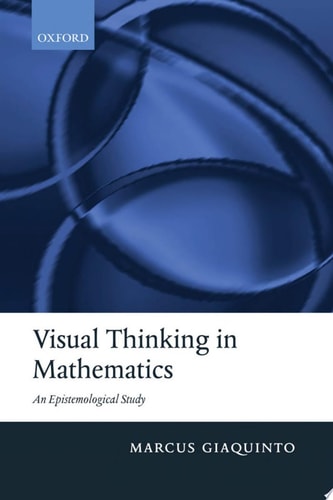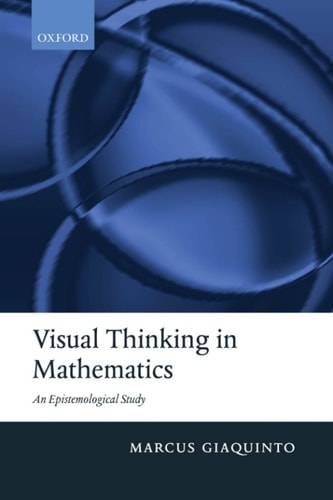
Visual Thinking in Mathematics
0
0
As an Amazon Associate and affiliate partner, Menrva Books earns from qualifying purchases. Learn more
Author Description
Visual thinking - visual imagination or perception of diagrams and symbol arrays, and mental operations on them - is omnipresent in mathematics. Is this visual thinking merely a psychological aid, facilitating grasp of what is gathered by other means? Or does it also have epistemological functions, as a means of discovery, understanding, and even proof? By examining the many kinds of visual representation in mathematics and the diverse ways in which they are used, Marcus Giaquinto argues that visual thinking in mathematics is rarely just a superfluous aid; it usually has epistemological value, often as a means of discovery. Drawing from philosophical work on the nature of concepts and from empirical studies of visual perception, mental imagery, and numerical cognition, Giaquinto explores a major source of our grasp of mathematics, using examples from basic geometry, arithmetic, algebra, and real analysis. He shows how we can discern abstract general truths by means of specific images, how synthetic a priori knowledge is possible, and how visual means can help us grasp abstract structures. Visual Thinking in Mathematics reopens the investigation of earlier thinkers from Plato to Kant into the nature and epistemology of an individual's basic mathematical beliefs and abilities, in the new light shed by the maturing cognitive sciences. Clear and concise throughout, it will appeal to scholars and students of philosophy, mathematics, and psychology, as well as anyone with an interest in mathematical thinking.
Menrva's Summary
THE THESIS
This book investigates whether visual thinking in mathematics serves merely as a psychological aid or possesses genuine epistemological functions for discovery, understanding, and proof. Marcus Giaquinto, a philosopher specializing in the intersection of mathematics and cognitive science, synthesizes philosophical inquiry with empirical research on mental imagery and numerical cognition. He argues that visual representations are integral to mathematical reasoning, providing a legitimate pathway to discerning abstract truths and grasping complex structures.
THE SCOPE MAP
What You Will Find
- Analysis of visual representations in geometry, arithmetic, algebra, and real analysis
- Integration of cognitive science research on perception and mental imagery
- Philosophical examination of synthetic a priori knowledge
- Historical context regarding mathematical epistemology from Plato to Kant
Scope Limits
- The text does not provide a comprehensive history of mathematical notation
- It does not serve as a practical manual for teaching visual pedagogy in classrooms
THE AUTHORITY PERSPECTIVE
Experts and scholars recognize this work as a significant contribution to the philosophy of mathematics, particularly for its bridge between classical epistemology and modern cognitive science. Readers frequently note the academic density of the prose, which requires a foundational understanding of both philosophical terminology and mathematical concepts to fully appreciate the arguments presented.
Page Count:
240
Publication Date:
2007-01-01
Publisher:
Clarendon Press
ISBN-10:
019153661X
ISBN-13:
9780191536618
Psychology
Philosophy
Epistemology
Visualization
Mathematics
Mind & Body
Philosophy of