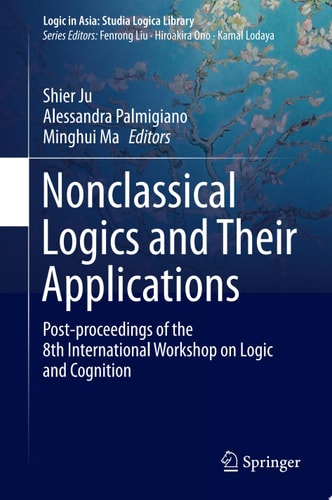
Nonclassical Logics and Their Applications
0
0
As an Amazon Associate and affiliate partner, Menrva Books earns from qualifying purchases. Learn more
Author Description
This edited book focuses on non-classical logics and their applications, highlighting the rapid advances and the new perspectives that are emerging in this area. Non-classical logics are logical formalisms that violate or go beyond classical logic laws, and their specific features make them particularly suited to describing and reason about aspects of social interaction. The richness and diversity of non-classical logics mean that this area is a natural catalyst for ideas and insights from many different fields, from information theory to game theory and business science. This volume is the post-proceedings of the 8th International Conference on Logic and Cognition, held at Sun Yat-Sen University Institute of Logic and Cognition (ILC) in Guangzhou, China in December 2016. The conference series started in 2001, and is organized by the ILC, often in collaboration with various international research groups. This eighth installment was jointly organized by ILC and Alessandra Palmigiano's Applied Logic research group. The conference series aims to foster the development of effective logical tools to study social behavior from a philosophical, cognitive and formal perspective in order to challenge the field of logic in ways that open up new and exciting research directions. Chapter "The Category of Node-and-Choice Forms, with Subcategories for Choice-Sequence Forms and Choice-Set Forms" of this book is available open access under a CC BY 4.0 license at link.springer.com
Menrva's Summary
THE THESIS
This volume explores the evolving landscape of non-classical logics and their practical applications, particularly in understanding social interactions. The book, a collection of papers from the 8th International Conference on Logic and Cognition, delves into logical formalisms that deviate from classical logic, making them adept at modeling social behavior. It highlights how the diversity of these logics serves as a nexus for interdisciplinary insights, drawing from fields such as information theory, game theory, and business science. The conference series itself aims to advance logical tools for analyzing social behavior from philosophical, cognitive, and formal viewpoints.
THE SCOPE MAP
- Exploration of non-classical logics that extend or modify classical logic principles.
- Focus on applications in describing and reasoning about social interaction.
- Interdisciplinary connections to information theory, game theory, and business science.
- Contributions from the 8th International Conference on Logic and Cognition.
- Papers presented at Sun Yat-Sen University Institute of Logic and Cognition (ILC).
- Discussion of logical tools for studying social behavior from multiple perspectives.
- Includes a chapter available as open access under CC BY 4.0 license.
THE AUTHORITY PERSPECTIVE
This collection is presented as a post-proceedings volume from a specialized conference, indicating a focus on current research and emerging perspectives within the field of non-classical logics. The interdisciplinary nature, bridging logic with social sciences and information theory, suggests it is aimed at academics and researchers seeking to apply formal logical methods to complex real-world phenomena. The inclusion of a specific open-access chapter further points to a commitment to disseminating research within the academic community.
Page Count:
154
Publication Date:
2020-01-31
Publisher:
Springer Nature
ISBN-10:
9811513422
ISBN-13:
9789811513428
Science
Non-Fiction
Philosophy
Computer Science
Information Theory
Logic
Game theory
Community Tags
Similar Books