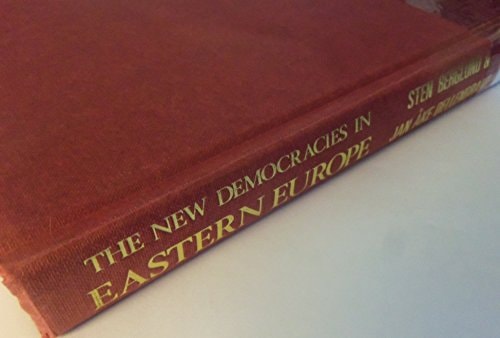
The New Democracies in Eastern Europe: Party Systems and Political Cleavages
0
0
As an Amazon Associate and affiliate partner, Menrva Books earns from qualifying purchases. Learn more
Author Description
Product Description This major book - the first of its kind - provides a unique up-to-date account of the party systems that have evolved in Eastern Europe since the revolutions at the end of the 1980s. The new political systems of Estonia, Latvia, Lithuania, Poland, Czechoslovakia, Hungary and Bulgaria are analysed and compared. It also includes an analysis of the most recent developments in Eastern Germany. The New Democracies in Eastern Europe presents a genuinely comparative perspective on the old and the new party systems. The breakdown of the old authoritarian system is shown to be a by-product of the built-in crisis in legitimacy which became progressively worse as the mistakes and failures of the communist regimes accumulated. A comparison between the political systems of the inter-war period with those of the present day shows that many of the difficulties encountered during the early periods of democracy are still present. As a result, the future of the new democratic structures in Eastern Europe is still uncertain. About the Author Edited by Sten Berglund, Professor of Political Science, University of Örebro, Sweden, Germany and the late Jan Åke Dellenbrant, formerly Reader in Political Science, University of Umeå, Sweden
Menrva's Summary
THE THESIS
The collapse of communist regimes in Eastern Europe has led to the emergence of new, often unstable, democratic party systems. This book analyzes and compares the evolving political landscapes of Estonia, Latvia, Lithuania, Poland, Czechoslovakia, Hungary, and Bulgaria in the aftermath of the late 1980s revolutions. It examines the breakdown of authoritarian rule, attributing it to inherent legitimacy crises exacerbated by regime failures, and contrasts contemporary democratic structures with those of the inter-war period, highlighting persistent challenges to democratic consolidation. The authors conclude that the future of these new democratic systems remains uncertain.
THE SCOPE MAP
- Analysis of party systems in Estonia, Latvia, Lithuania, Poland, Czechoslovakia, Hungary, and Bulgaria.
- Comparative study of old and new party systems in Eastern Europe.
- Examination of the breakdown of authoritarian communist systems.
- Discussion of the role of legitimacy crises and regime failures.
- Comparison of inter-war political systems with contemporary democratic structures.
- Inclusion of recent developments in Eastern Germany.
- Assessment of the ongoing challenges to new democratic structures.
THE AUTHORITY PERSPECTIVE
This comparative study offers a timely analysis of the nascent democratic party systems in post-communist Eastern Europe. The authors' detailed examination of individual countries and their comparison with historical models provides a robust framework for understanding the complexities of democratic transition. The work is noted for its comprehensive scope, covering a significant portion of the region and delving into the persistent difficulties faced by these new democracies. The uncertain future of these political structures, as highlighted by the authors, remains a key takeaway for scholars and observers of the region.
Page Count:
272
Publication Date:
1991-03-01
Publisher:
Edward Elgar Publishing
ISBN-10:
1852785241
ISBN-13:
9781852785246
History
Non-Fiction
Politics
Eastern Europe
Democracy
Comparative Politics
Community Tags
Similar Books