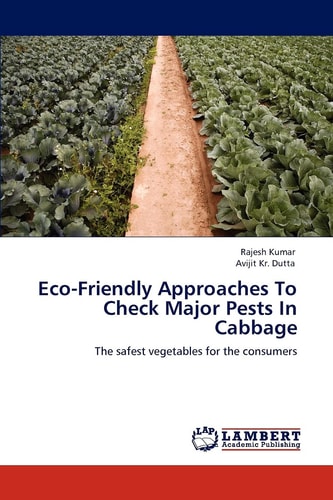
Eco-Friendly Approaches to Check Major Pests in Cabbage
0
0
As an Amazon Associate and affiliate partner, Menrva Books earns from qualifying purchases. Learn more
Author Description
Two major insect-pests viz. Diamond Back Moth (DBM) [Plutella xylostella] and two species of aphid such as Indian Mustard Aphid [Lipaphis erysimi] and Green Peach Aphid [Myzus persicae] are found detrimental for the cultivation of cabbage [Brassica oleracea var. capitata]. Different bio-pesticides were reported to be effective in suppressing the population of DBM and aphids infesting cabbage. Thus an attempt has been made in the present investigation to find the efficacy of different bio-pesticides on leading insect-pests of cabbage. Due to minimum infestations of these pests after the application of different bio-pesticides such as cow urine, garlic + chilli extract, neem based insecticide like vanguard, Bacillus thuringiensis var. kurstaki (B.t.k) etc. and incorporation of different inter crop components like garlic (Allium sativum), coriander (Coriandrum sativum), African marigold (Tagetes erecta), fenugreek (Trigonella foenum-graecum), tomato (Solanum lycopersicum) and French bean (Phaseoulus vulgaris) the highest yield as well as benefit cost ratio was received. We hope this book will help to all researchers and growers for growing the safest cabbage for human consumption.
Menrva's Summary
THE THESIS
This investigation examines the efficacy of various bio-pesticides and intercropping strategies in managing key cabbage pests. The study focuses on the Diamond Back Moth (DBM), Indian Mustard Aphid, and Green Peach Aphid, which significantly impact cabbage cultivation. Researchers applied treatments including cow urine, garlic-chilli extract, neem-based insecticides like vanguard, and Bacillus thuringiensis var. kurstaki (B.t.k). The incorporation of intercrops such as garlic, coriander, African marigold, fenugreek, tomato, and French bean was also evaluated.
THE SCOPE MAP
- Efficacy of cow urine as a bio-pesticide.
- Effectiveness of garlic + chilli extract against pests.
- Impact of neem-based insecticide (vanguard) on pest populations.
- Role of Bacillus thuringiensis var. kurstaki (B.t.k) in pest suppression.
- Benefits of intercropping with garlic (Allium sativum).
- Advantages of intercropping with coriander (Coriandrum sativum).
- Influence of African marigold (Tagetes erecta) intercropping.
- Effects of fenugreek (Trigonella foenum-graecum) intercropping.
- Impact of tomato (Solanum lycopersicum) intercropping.
- Benefits of French bean (Phaseoulus vulgaris) intercropping.
- Analysis of yield and benefit-cost ratio from different treatments.
THE AUTHORITY PERSPECTIVE
The study presents findings on the application of various bio-pesticides and intercropping methods for controlling major pests in cabbage cultivation. It details the effectiveness of treatments like cow urine, garlic-chilli extract, neem-based insecticides, and B.t.k, alongside intercropping with several plant species. The research aims to provide practical guidance for growers and researchers seeking to produce safer cabbage.
Page Count:
84
Publication Date:
2012-03-01
Publisher:
Lap Lambert Academic Publishing GmbH KG
ISBN-10:
3848416840
ISBN-13:
9783848416844
Non-Fiction
Science
Horticulture
Agriculture
Pest Control
Entomology
Community Tags
Similar Books