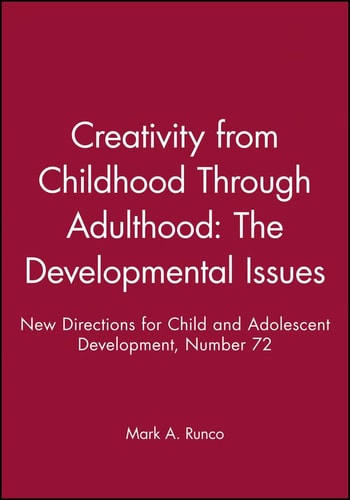
Creativity from Childhood Through Adulthood: The Developmental Issues
0
0
As an Amazon Associate and affiliate partner, Menrva Books earns from qualifying purchases. Learn more
Author Description
The various chapters of this volume emphasize different periods of development. There is an argument for the creativity of children, another for adolescence, and another for adulthood. Continuities and discontinuities across the life span are described, as are numerous developmental issues, such as the role of knowledge and experience, and the relationships between creativity, play, and deviance. Why development and creativity? One reason is that developmental issues cut across many other topics in studies of creativity. The biological underpinnings of creativity, for example, probably exert their influence in different ways at different points in development, and the cognitive and emotional mechanisms of creative thinking vary in different chronological stages. Even more obvious are the educational implications of developmental theories of creativity. The conclusion to this volume suggests that we must understand the development of creativity or we will not really understand creativity itself. This is the 72nd issue of the journal series New Directions for Child Development.
Menrva's Summary
THE THESIS
This volume investigates the multifaceted nature of creativity across the entire human lifespan, from childhood through adulthood. It examines distinct developmental periods, arguing for the unique characteristics of creativity in children, adolescents, and adults. The work explores continuities and discontinuities across these stages, addressing key developmental issues such as the influence of knowledge and experience, and the complex relationships between creativity, play, and deviance. Ultimately, the book posits that a comprehensive understanding of creativity is impossible without first understanding its development.
THE SCOPE MAP
- Analysis of creativity specific to childhood development.
- Exploration of creativity during adolescence.
- Examination of creativity in adulthood.
- Discussion of continuities and discontinuities in creativity across the lifespan.
- Investigation into the role of knowledge and experience in creative development.
- Analysis of the relationships between creativity, play, and deviance.
- Consideration of the biological, cognitive, and emotional underpinnings of creativity at different developmental stages.
- Implications of developmental theories of creativity for education.
THE AUTHORITY PERSPECTIVE
This volume, the 72nd issue of New Directions for Child and Adolescent Development, presents a collection of essays focusing on creativity across different life stages. The chapters offer arguments for the distinct creative capacities of children, adolescents, and adults, while also exploring the transitions between these phases. It delves into developmental issues such as the impact of experience and the interplay of creativity with play and unconventional behavior. The overarching conclusion suggests that understanding creativity fundamentally requires understanding its developmental trajectory.
Page Count:
98
Publication Date:
1996-09-13
Publisher:
Jossey-Bass
ISBN-10:
0787998710
ISBN-13:
9780787998714
Non-Fiction
Psychology
Education
Creativity
Community Tags
Similar Books